


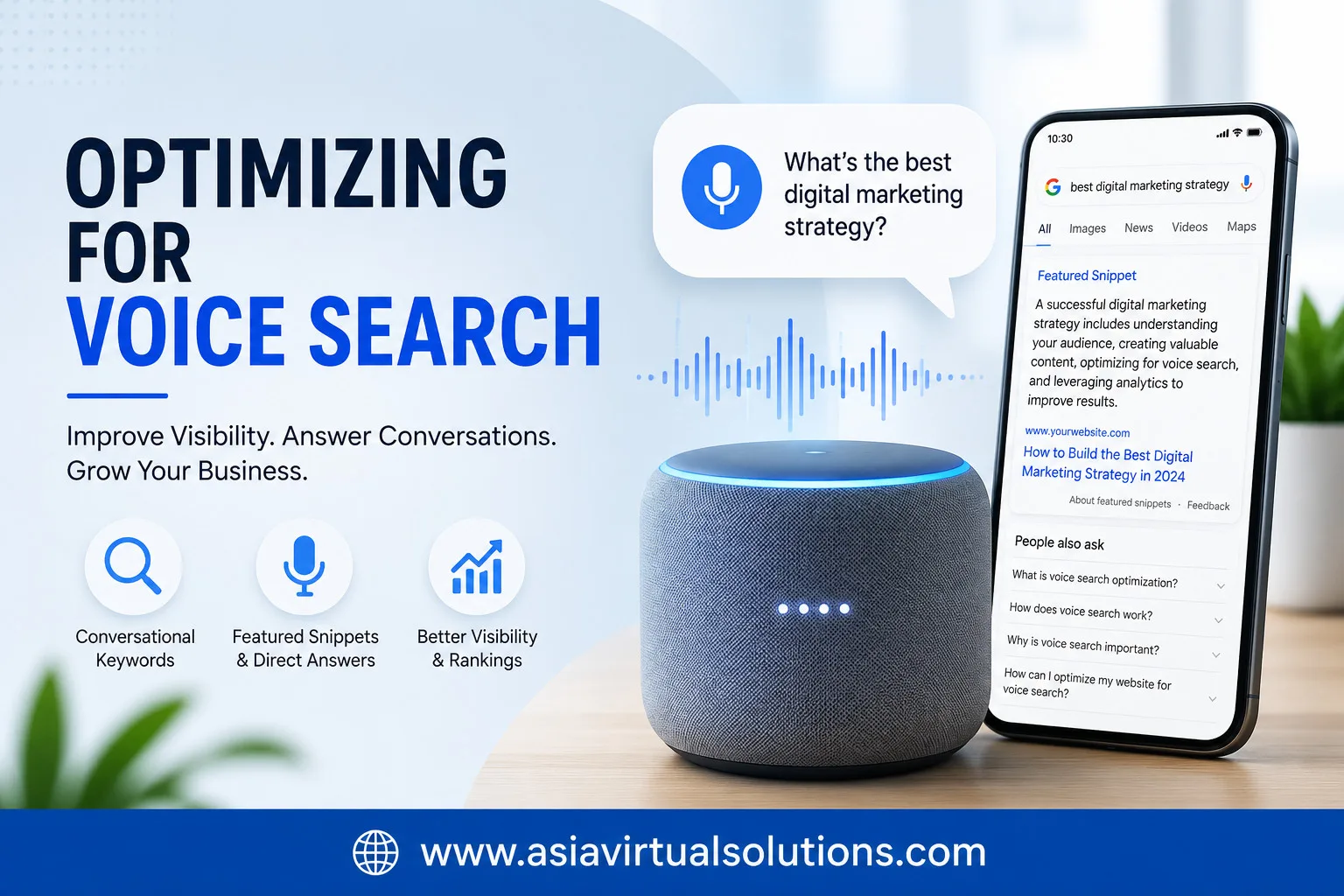
Voice search has been called the next big thing in SEO for close to a decade. The reality in 2026 is quieter than the predictions, but it is not nothing — and the work it asks of you now overlaps almost completely with the work that gets you cited by AI assistants. Here is what actually matters.
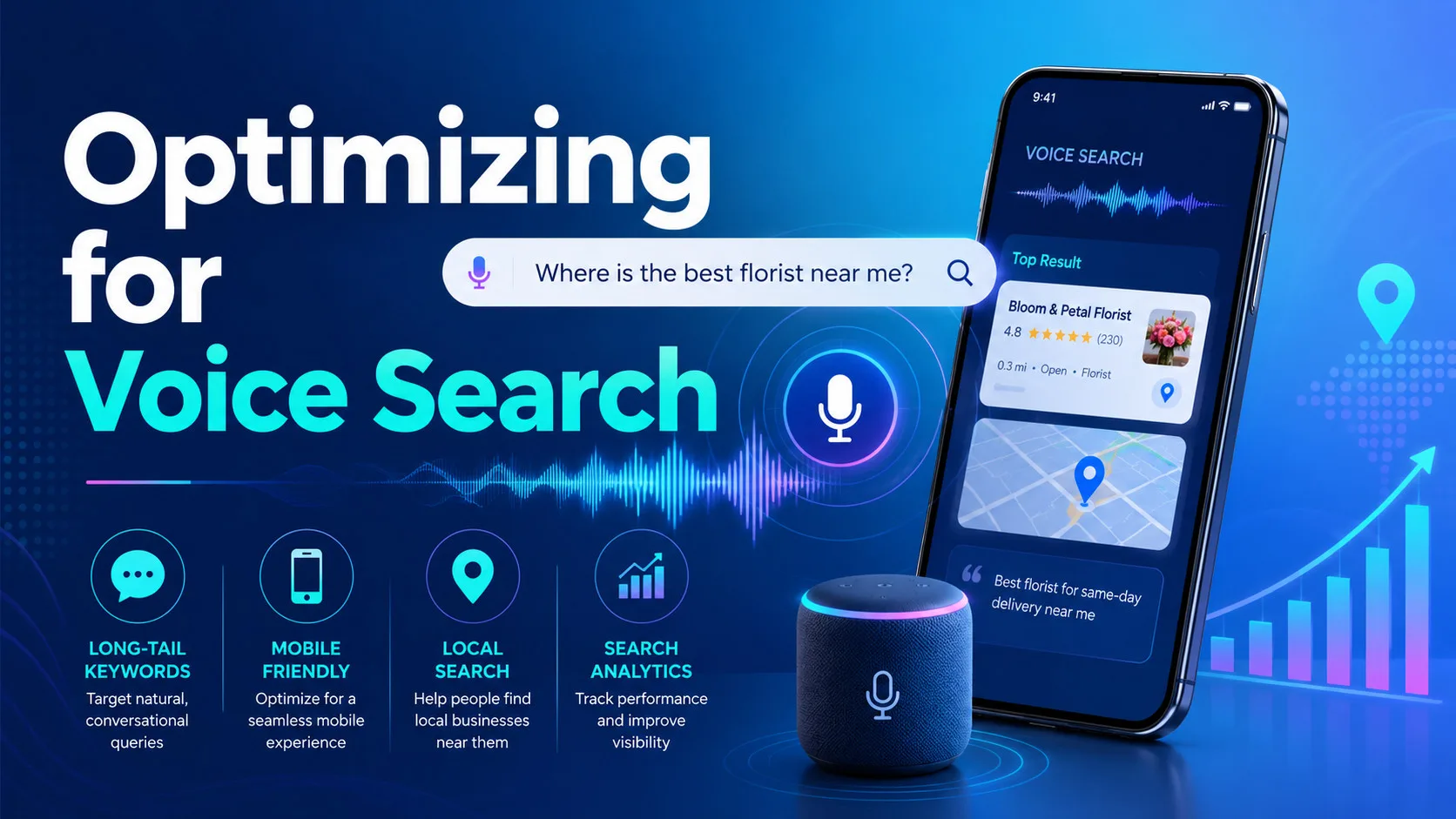
What is voice search optimization?
Voice search optimization is the practice of structuring a page so it can be read aloud as a single, self-contained answer. Instead of competing for a position in a list of links, you are competing to be the one result an assistant speaks. That means direct answers, question-shaped headings, clean structured data and fast mobile pages.
How is a spoken query different from a typed one?
Spoken queries are longer, phrased as full questions, and far more likely to carry local or immediate intent. Someone types best florist Miami. The same person asks which is the best florist near me that is open right now. Three words become eleven, and the second version contains the intent the first only implies.
| Typed search | Voice search | |
|---|---|---|
| Length | 2 to 4 words | 7 to 12 words |
| Phrasing | Keyword fragments | Full questions, natural speech |
| Intent | Often implied | Usually stated outright |
| What you get back | A page of results to choose from | One answer, sometimes with a source named |
| Device | Desktop and mobile | Phone, speaker, car, TV, watch |
The practical consequence is that short head terms do less for you here. Long-tail phrases and question phrases do more. If your pages are built around two-word keywords, that is the gap to close.
Is voice search still worth optimizing for in 2026?
Yes, but not for the reason the industry has been repeating. The often-quoted claim that half of all searches would be voice by 2020 never came true, and no search engine has ever published a figure that supports it. Treat any article still citing it with suspicion.
What is true is narrower and more useful. People do speak to their devices constantly, but mostly for quick, low-commercial tasks: timers, weather, music, navigation, smart home controls. Those queries were never going to send you buyers.
The real reason to do this work: optimizing for a spoken answer and optimizing to be quoted by an AI assistant are now the same job. Both reward a clear question, a direct answer near the top of the page, and structured data that says what the page is. Effort spent here pays twice.
How do you optimize a page for voice search?
Seven steps, in the order worth doing them:
- Find the questions people actually ask. Pull the question phrases your pages already receive from Search Console. Question words — how, what, where, which, can, is — are the signal to look for.
- Make the question a heading. Use the exact phrasing a person would say, as an H2 or H3. An assistant matching a spoken question to a page is matching against your headings first.
- Answer it in the first 40 to 60 words underneath. No preamble. A self-contained answer that makes sense read aloud, with no reference to anything above it on the page.
- Add structured data in JSON-LD. FAQPage and HowTo markup tell a machine which text is the answer. Google has preferred JSON-LD over microdata for years, so if your site still uses microdata, that is worth updating.
- Fix mobile and page speed. Spoken queries are answered from indexed pages, and slow pages get crawled and surfaced less. Test on real devices, not only in a desktop browser.
- Claim and complete your local listings. A large share of spoken questions are local. For those, the answer is pulled from your Google Business Profile and other directories, not from your on-page copy. Name, address, hours and phone number need to be right everywhere. Our guide to local SEO tools covers this in more depth.
- Write one page per question cluster. Thin pages targeting a single long phrase rarely hold up. Group related questions and answer them properly on one strong page.
Which voice assistants actually matter now?
Three, and the list is shorter than it used to be. Microsoft retired Cortana, so any advice still telling you to optimize for it is out of date.
- Google Assistant and Gemini — the largest share, and the one drawing on Google’s index and your Business Profile.
- Siri — routes web answers through Google, so ranking well in Google covers most of this.
- Alexa — strongest in the home and on commerce questions rather than general web search.
Add to those the assistants inside ChatGPT, Gemini and Perplexity, which people now speak to directly. They do not use a ranking list at all. They read pages and quote them.

Can you track voice search traffic?
Not directly. Neither Google Analytics nor Search Console reports whether a query was spoken or typed, and despite years of speculation, no such report has ever shipped. Anyone promising you a voice search visitor number is estimating.
What you can track are reasonable stand-ins. In Search Console, filter your queries for question words and watch impressions and position on those. Watch mobile against desktop separately. Watch which pages hold featured snippets, because those are the pages most likely to be read aloud. None of this is exact, and it does not need to be — the actions it points you toward are the same either way.
What this means if you build links at scale
Nothing here replaces the fundamentals. A page cannot be spoken as an answer if it is not indexed and does not rank, and that still comes down to relevance, authority and links. What changes is where you point that authority: at pages built around real questions rather than at thin pages built around two-word keywords.
Frequently asked questions
What is voice search optimization?
Voice search optimization is structuring a page so it can be read aloud as a single, self-contained answer. It combines question-shaped headings, a direct answer in the first 40 to 60 words, JSON-LD structured data, fast mobile pages and accurate local listings.
Is voice search still worth optimizing for in 2026?
Yes, though not because voice replaced typing — that prediction never came true. It is worth doing because the same work makes your pages quotable by AI assistants like Gemini, ChatGPT and Perplexity, which answer spoken questions by reading and citing pages rather than ranking them.
What is the difference between voice search and text search?
Spoken queries run roughly 7 to 12 words against 2 to 4 for typed ones, are phrased as complete questions, and state their intent outright. Voice usually returns one answer rather than a page of links, and carries local intent far more often.
Does schema markup help with voice search?
It helps a machine identify which text on your page is the answer to a question. FAQPage and HowTo markup in JSON-LD are the most useful types. Schema does not make a page rank, but it makes an already-ranking page easier to quote accurately.
Can you track voice search traffic in Google Analytics?
No. Google Analytics and Search Console do not distinguish spoken queries from typed ones, and no such report exists. Use indirect signals instead: filter Search Console for question words, compare mobile against desktop, and track which pages hold featured snippets.









 English
  简体中文
简体中文  Deutsch (Sie)
  Bahasa Indonesia
  Italiano
  日本語
日本語  한국어
한국어  Português do Brasil
  Русский
  Español de México
  ไทย
ไทย  Tiếng Việt
  Türkçe