


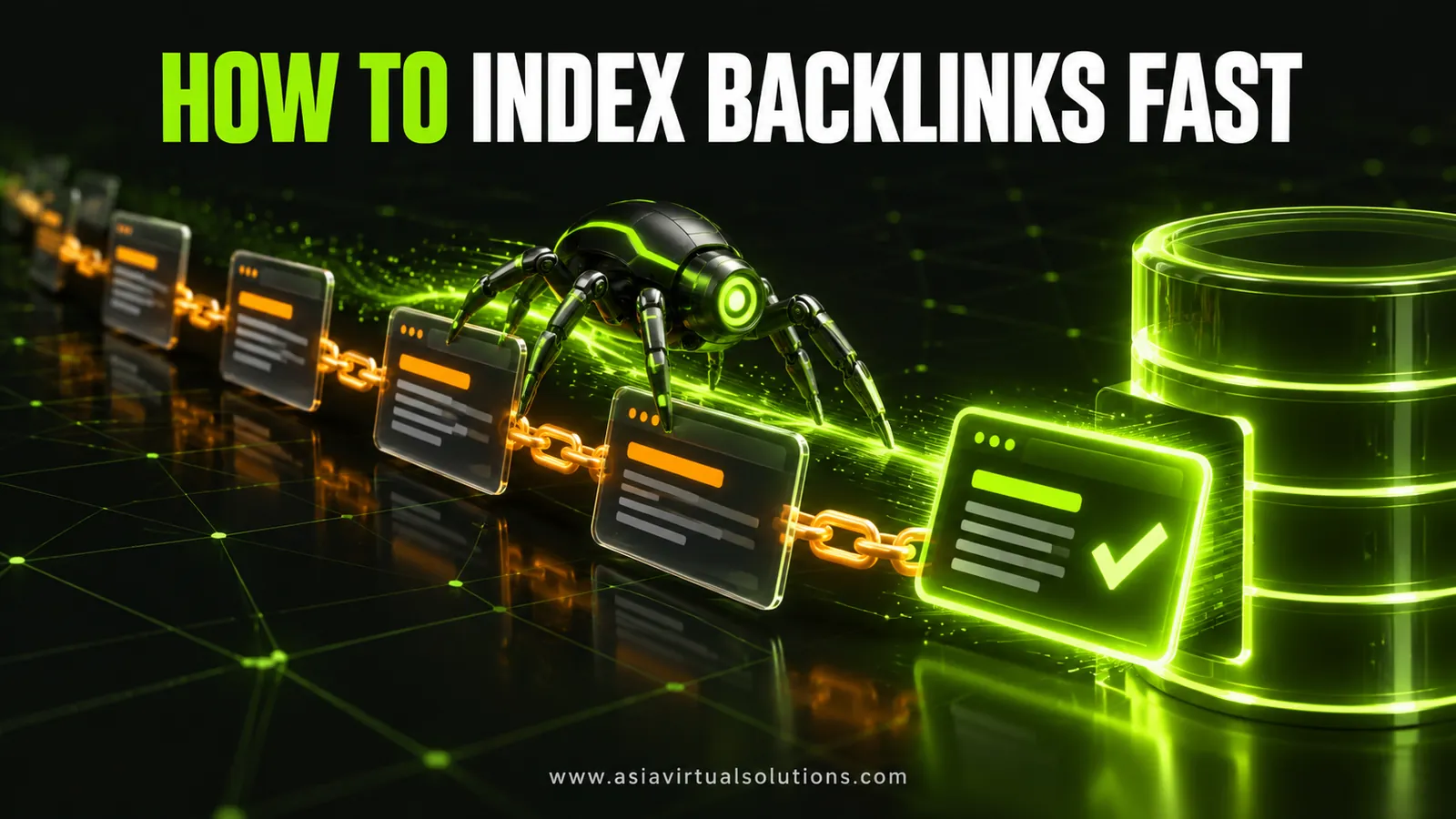
Backlinks are still one of the main signals Google uses to rank pages. In some niches you cannot rank at all without a solid backlink profile, which is why SEOs spend real money on link building.
There is a catch. A backlink only counts if Google has indexed the page it sits on. If that page never makes it into the index, the link does nothing for you, and the time and money behind it are wasted.
This guide covers how to check whether your backlinks are indexed, why Google skips some of them, and 17 methods to get them indexed faster. I updated it in October 2026: dead tools are gone, prices are re-checked, and the methods that no longer work the way they used to are marked as such.
Quick answer: how to index backlinks fast
- Check first. Search the exact URL in Google or use URL Inspection in Search Console. Only work on links that are not indexed.
- Use an indexing service for volume. Most now refund or re-credit links that do not get indexed.
- Request indexing in Search Console for a few important URLs on sites you control.
- Point links at the linking page (tiers, web 2.0s, social shares) so Google finds it through more than one path.
- Fix the page, not just the link. Thin, duplicate or blocked pages often stay out of the index whatever you do.
What is backlink indexing?
Google’s index is its database of pages it can show in search results. Google does not search the live web when someone types a query. It searches its index.
To get a page into the index, Google first has to discover the URL, then crawl it, then decide whether the page is worth keeping. Backlink indexing is the same process applied to the page that holds your link. When that page is indexed, Google can see and count your link.
Why does backlink indexing matter?
A link on a page that is not indexed has no value. Google cannot count a link it has never processed.
Google’s systems are far more selective than they were a few years ago. Google’s Gary Illyes said in 2023 that quality is “the biggest driver for most of the indexing and crawling decisions that we make”. In practice that means many link pages are crawled and then left out. If you build links without checking indexing, you are paying for links that may never count.
How do you check if a backlink is indexed?
Use one or more of these checks before you spend anything on indexing.
Search the exact URL in Google
Copy the URL of the page that holds your link, paste it into Google and search. If the page shows up, it is indexed and Google can see your link. If it does not, the page is probably not indexed.
Use the site: operator
Type site: followed by the page URL, for example site:example.com/page-with-your-link. A result means the page is indexed. Treat this as a quick check only. The site: operator is not a complete list of what Google has indexed, so an empty result is a hint, not proof.
Use URL Inspection in Search Console
If you own the linking site, or the owner will check for you, open Google Search Console, paste the URL into the inspection bar and press enter. Search Console tells you whether the URL is on Google and, if not, why.
Use an index checker
For larger lists, use a bulk index checker. Several indexing services include one free, including IndexMeNow and Sinbyte. Backlink monitoring tools also flag links that have dropped out of the index or been removed.
Why is Google not indexing my backlinks?
These are the most common reasons a link page stays out of Google’s index.
The page is spammy
Pages packed with outbound links to unrelated or low-quality sites, or comment sections flooded with links, rarely get indexed. Google sees the whole page as spam, and your link goes down with it. Avoid pages with hundreds of outbound links or links to obvious spam.
The content is thin
Short pages with little real information often get crawled and then left out of the index. Google has never published a minimum word count, so do not chase a number. Make sure the page actually covers its topic.
The content is duplicate
If the page copies content from another site, or repeats other pages on the same site, Google usually indexes one version and drops the rest. Your link needs to sit on unique content to have a fair chance.
The linking page carries a noindex tag
A noindex robots meta tag or X-Robots-Tag header tells Google not to index the page. If the page that holds your link has one, the page will never be indexed, and nothing you do from the outside will change that.
The page is blocked from crawling
If the site’s robots.txt blocks Googlebot from the page, Google cannot crawl it and cannot see your link. Method 8 below shows how to check.
The site has lost Google’s trust
Pages on sites that have been hit by a manual action or have lost most of their search visibility are often ignored. A simple check: if a site still gets steady organic traffic, Google is still indexing and showing its pages.
Google simply chose not to index it
Sometimes nothing is technically wrong. Google’s John Mueller wrote in June 2025: “We don’t index all content, and what we index can change over time.” A page can be indexed this month and dropped next month. This is why you should re-check indexing over time, not just once.
17 proven ways to index backlinks fast
Start with the methods that fit your volume. A handful of important links can go through Search Console. Thousands of tier links need an indexing service.
1. Use a backlink indexing service
Indexing services push your URLs in front of Google’s crawlers, then report which ones made it into the index. This is the practical option when you have hundreds or thousands of links, for example from a GSA SER tier.
Most of the established services now return credits for links that do not get indexed, so you mainly pay for results. Prices have also moved a lot since this post was first written in 2022, so here is what the main services charge today.
| Service | Entry price | Free option | If a link is not indexed |
|---|---|---|---|
| Omega Indexer | $19 per month for 190 credits (about $0.10 per link) | None | Credit returned if not indexed within 24 hours. Credits do not expire |
| IndexMeNow | €59 for 60 credits, cheaper per link on larger packs | Free index checker | Credit returned after 10 days |
| Links Indexer | Paid plans from $9.99 per month | 100 links per day, 1,000 per month | No refunds on used plans |
| SpeedyIndex | $5 for 5,000 tokens (100 tokens per link) | Small signup bonus | Tokens returned if not indexed by day 7 |
| Rapid URL Indexer | $25 for 500 credits | None | Credit returned after 14 days (standard mode) |
| Sinbyte | Credit packs, priced per link | 100 free links on signup, free index checker | Not stated on the site |
Our pick: at Asia Virtual Solutions we use and recommend Omega Indexer. It is web based, credits never expire, and you get the credit back for any link that does not get indexed. It also has an API if you want to send links automatically.
Do not resubmit the same URLs again and again. Submit once, wait for the provider’s checking period, and only resend links that are still not indexed.
2. Request indexing in Google Search Console
For a small number of important pages, Search Console is the safest option. It only works for sites you have verified, so for backlinks on other people’s sites you need to ask the owner.
- Sign in to Search Console and select the property.
- Paste the URL into the inspection bar at the top and press enter.
- Click Request indexing.
Google says there is a daily limit on index requests but does not publish the number. For many URLs, submit a sitemap instead.
You may read about the Google Indexing API as a shortcut. Google only supports it for job posting pages and livestream videos, so it is not a tool for backlinks.
3. Ping the page and add it to an RSS feed
Pinging used to be a standard indexing trick. It matters much less today. Google announced in June 2023 that it was retiring its sitemap ping endpoint, and that endpoint no longer works.
Ping services such as Ping-O-Matic notify blog directories and feed services, not Google. They are free, so they do no harm, but treat them as an extra and not as an indexing method.
A more useful version of the same idea is to put your link pages into an RSS feed and promote the feed. We explain how in how to promote an RSS feed with GSA Search Engine Ranker.
Posting the page that holds your link on X, Pinterest, Reddit, LinkedIn or Facebook gives Google another path to find it. Public posts on these platforms get crawled, and the visits they bring show the page is being used.
Be realistic about what this does. Google’s John Mueller has said: “We don’t use likes as a ranking factor.” Social posts help a page get discovered and visited. They do not push rankings directly. A post with no engagement does little, so share, comment and get a few real people to click.
If you want this done at scale, our Social Signals service sends shares to the URLs you choose.
5. Create web 2.0 links to the link page
Web 2.0 sites are free blogging platforms such as Blogger, Tumblr, WordPress.com, Wix and Weebly. Write a post on one of them and link to the page that holds your backlink. Google crawls these platforms often, so it follows your link to the page you want indexed.
Make each post unique and readable, give it real substance, and keep it to about three links. A short spun post stuffed with links is likely to stay unindexed itself, and then it helps nothing. For examples of platforms worth using, see our list of high DA web 2.0 sites.
If you would rather not build these yourself, Asia Virtual Solutions offers a Web 2.0 posting service with structured content on DA50+ sites.
6. Link to the page from your own website
If your own site is already indexed and crawled regularly, it can lead Google to your backlinks. Add a link from one of your pages to the page that holds your backlink, then request indexing for your page in Search Console (method 2).
When Google recrawls your page, it follows the link and finds the backlink page. This works well for a small number of important links. It is not practical for bulk.
7. Build links on sites that get real traffic
Pages on sites that Google already trusts and crawls often get indexed faster. The simplest sign of that trust is steady organic traffic.
Domain authority scores alone can mislead, because some sellers inflate them to sell links. Check that the site actually gets search traffic. Guest posting on real sites, and studying where your competitors get their links, are good ways to find these placements.
8. Make sure Googlebot can reach the page
If the linking page blocks Googlebot, it cannot be crawled or indexed. If you have access to the site, or the owner will check for you, use Search Console:
- Inspect the URL in Search Console.
- Open the page indexing details and look at Crawl allowed? and Indexing allowed?
- If either says No, the page is blocked by robots.txt or carries a noindex tag. That has to be fixed on the site before anything else will work.
9. Check for noindex and nofollow
Two different things are often mixed up here.
- noindex is a page-level instruction. A page with a noindex tag will not be indexed, so any link on it will not count.
- nofollow is a link-level attribute. Since March 2020 Google treats it as a hint for crawling and indexing rather than a strict rule. A nofollow link can still help Google discover a page. Read more in the value of nofollow links.
10. Make sure the link page is not orphaned
Google finds pages by following links. A page with no internal links pointing to it is hard to discover and often gets crawled late or not at all.
If you control the linking site, or can ask the owner, add a few internal links to the page soon after it is published:
- Use clear, descriptive anchor text
- Link from pages that already rank or get traffic
- Keep the internal links followed
- Place the link high in the content where it is easy to find
- Add the links by hand instead of using an auto-linking tool
11. Build quality, relevant backlinks
Low-quality, unrelated links have not worked since Google’s Penguin update in 2012. Google is also less likely to index the pages they sit on. Relevant links on decent pages tend to get indexed with little extra effort.
- Make sure the linking site covers a topic related to yours
- Make sure the article itself is relevant to the page you link to
- Choose sites that get organic traffic
- Check that the site has a clean backlink profile
- Avoid sites with large numbers of outbound links to low-quality sites
- Support your best links with tier links (method 14)
Bookmarking the link page on public bookmarking and curation sites gives Google more paths to it, and some of those platforms bring visitors too.
The list of platforms has changed a lot. StumbleUpon closed in 2018, and Mozilla shut down Pocket on 8 July 2025, so remove both from any list you use. These are still running in October 2026:
- Scoop.it
- Slashdot (for technology stories)
- Digg (relaunched in 2025 and still rebuilding in 2026)
Space your submissions out. Posting many links in a short time is the quickest way to get an account suspended. Our guide to social bookmarking covers this in more detail, and our Multi-Platform SEO Backlinks Package handles it for you.
13. Post the page on your Google Business Profile
If you have a Google Business Profile, you can publish an update post that links to a page. Google shows these posts in the “From the owner” section on Search and Maps.
This only works for your own profile, so it suits links to your own content best. You can also ask a site owner who links to you to share the page on their profile. Posts are archived after about six months. For more ways to use your profile, see 3 tips to optimize your Google Business Profile.
14. Build tiered links
Tiered link building means building links to your backlinks. Tier 2 links point at your tier 1 backlinks, and tier 3 links point at tier 2. Each tier gives Google more paths to crawl down to the links above it, which helps them get discovered and indexed.

A common setup is web 2.0 posts as tier 1, bookmarks and articles as tier 2, and larger-volume links as tier 3. No method guarantees that every link gets indexed, but tiers do improve the odds for your important links.
For how to structure the tiers and where indexing fits in, see our modern tiered link-building workflow. If you want tiered projects built for you, look at GSA Search Engine Ranker Projects, done for you.
15. Get links on sites Google crawls often
News sites and busy blogs publish new content every day, so Googlebot visits them constantly. A link on one of these sites is usually found quickly.
There is no longer a “Google News approved” list to apply for. Since 2025, Google says that content from publishers following its policies is automatically eligible for Google News. What matters is how often a site publishes and how often Google crawls it, not a badge.
If you write a story for a news site, keep the links to one or two. A story stuffed with links will not be accepted, or will not be indexed.
16. Use Google Sites
Google Sites is Google’s free website builder. Create a site, publish a unique, readable article on it, and link to the page that holds your backlink.
Keep the number of links low so the page does not look like spam. Once the article is live, you can request indexing for it in Search Console if you verify the site, which is free.
17. Be patient and re-check
Google indexes pages on its own schedule. Many link pages get indexed within days, others take weeks, and some never make it in. Google does not publish a timeframe.
If a link is not indexed after a reasonable wait, go back to the reasons above and check the page itself. If the page is fine, send it to an indexing service or build a few tier links to it. Then check again, because pages can also drop out of the index later.
Frequently asked questions about backlink indexing
What is a backlink indexer?
A backlink indexer is a service that gets the pages holding your links in front of Google’s crawlers so they are crawled and considered for indexing. Most indexers also check which URLs made it into the index, and many return credits for links that did not.
How long does it take Google to index a backlink?
Google does not publish a timeframe. Pages on sites that Google crawls often can be indexed within days. Pages on rarely crawled sites can take weeks, and some never get indexed. Check again after one to two weeks before you take further action.
Which tool should I use to index my backlinks?
For a few important URLs on sites you control, use URL Inspection in Google Search Console. For larger volumes, use an indexing service. At Asia Virtual Solutions we use and recommend Omega Indexer. IndexMeNow, SpeedyIndex and Rapid URL Indexer are also established options.
Do social signals help backlinks get indexed?
They can help Google discover a page, because public social posts get crawled and bring visits. Google’s John Mueller has said likes are not a ranking factor, so treat social sharing as a discovery method, not a ranking boost.
How many backlinks per day is safe?
Google does not publish a safe number. What matters more is that the pace and quality fit your site. A new site gaining thousands of links overnight looks unnatural. Building steadily over time, and putting your best links on tier 1, is the safer approach.
Why are my backlinks not indexing?
The most common reasons are thin or duplicate content on the linking page, a noindex tag, a robots.txt block, a spammy page, or a site that has lost Google’s trust. Sometimes Google simply chooses not to index a page even when nothing is technically wrong.
Can I force Google to index a backlink?
No. Nobody can force Google to index a page. You can only help Google find it and make the page worth indexing. Search Console requests, indexing services and tier links all improve the odds, but Google makes the final decision.
Which indexer does Asia Virtual Solutions recommend?
We use and recommend Omega Indexer. It is web based, its credits do not expire, and it returns the credit for any link that is not indexed within 24 hours.
Which method should you start with?
Indexing is part of link building, not an afterthought. A link that never gets indexed is a link you paid for and never received.
If you publish good content on decent sites, many of your links will get indexed on their own. Check them anyway. For everything that does not make it, use Search Console for your most important URLs and an indexing service for the rest, then support the links that matter with tiers.
For a free, manual approach, read our companion guide on how to get your links indexed without spending a dime.
Running GSA SER and not sure your links are being built and indexed the right way? We have been running GSA SER campaigns since 2012 and can check your setup with you.



 English
  简体中文
简体中文  Deutsch (Sie)
  Bahasa Indonesia
  Italiano
  日本語
日本語  한국어
한국어  Português do Brasil
  Русский
  Español de México
  ไทย
ไทย  Tiếng Việt
  Türkçe