


Content is the part of SEO that never finishes. You need articles for your money site, for the tier one properties pointing at it, and for the web 2.0s and profiles feeding those. Writing all of it yourself stops being possible the moment you run more than one project.
So most of us buy content. That is where it gets difficult. Two suppliers can quote the same price for the same word count and deliver work that is nothing alike. One arrives formatted, researched and ready to publish. The other arrives as a wall of text that needs fifteen minutes of repair before it can go anywhere. Multiply that across a hundred articles and the cheaper order costs you a working week.
This guide covers what a content service should actually deliver, the questions that separate a good supplier from a bad one, and how to match what you buy to where it is going.
💡 In short
An SEO article writing service produces publish-ready articles from a topic or keyword you supply, including research, headings, formatting, and an originality check.
The price is the easy part to compare. These are the things that actually decide whether an order was worth buying.
- Ask for a real sample from a past order before you buy anything. A marketing page is not a sample.
- Check originality, formatting, keyword and anchor control, turnaround, languages, ownership, and the revisions policy.
- Match the quality you pay for to where the article goes. Your money site and a tier three property do not need the same thing.
- AI article packs win on cost, speed and volume. Human writers win on first-hand experience and original opinion.
- You should own every article outright the moment it is delivered, with no licence and no attribution.
🎯 What an SEO article writing service actually does
A content service takes your topic or keyword and returns a finished article. That is the simple version, and it is the version most sales pages stop at.
What you are really paying for is everything in between. Research on the subject so the article says something true. A structure the reader can follow. Headings that match the way people actually search, so the piece has a chance of picking up long-tail queries you never targeted. Formatting you do not have to rebuild. And a check that the text is not already published somewhere else.
Plenty of services skip most of that and send 500 words of padding. That gap is what you are really paying for.
There are three ways to buy, and they are not competing for the same job.
| Option | Cost per article | Speed | Best for |
|---|---|---|---|
| Freelance writer | Highest | Slowest | Flagship pages, anything needing a named author |
| Content agency | High | Medium | Ongoing programmes with editorial oversight |
| AI article packs | Lowest | Fastest | Volume, tiers, supporting and category pages |
Most campaigns need all three at different points. The mistake is paying agency rates for tier two filler, or pushing bulk content onto the page that has to convert.
✅ What to check before you buy
Seven things decide whether an order is worth the money. For each one there is a question worth asking before you pay, and an answer that should make you walk away.
1. Originality, and how it is actually proven
Duplicate content wastes any link you point at it. But “unique” covers several different things and suppliers use the word loosely. Text can be unique in the sense that no exact match exists, while still being a lightly spun version of a page that ranks. It can also be unique to the internet but sold to three other customers in the same week.
Ask: which tool do you check with, will you send me the report, and is the same article ever sold to another customer? A supplier who checks properly will name the tool without hesitating and attach a report if you ask. One who answers “all our content is 100% unique” and nothing else has told you nothing.
2. Structure and formatting
This is the factor people underestimate, and it is the one that quietly costs the most. An article that arrives as one undifferentiated block takes ten to fifteen minutes to break up, add headings to, and format. On a hundred-article order that is over twenty hours of your time, which usually costs more than the discount that tempted you.
Good structure means H2 and H3 headings that answer sub-questions rather than just labelling paragraphs, paragraphs of three or four lines, lists where a list actually helps, and a table when the topic involves a comparison. Those headings are also what gets your article pulled into AI answers and featured snippets, so they are worth more than tidiness.
Ask: send me a real article from a past order, not a page from your website. If they will not, that is your answer.
3. Keyword handling and anchor text control
These are two separate things and suppliers often only handle the first. Keyword placement means the term appears in the title, in an early paragraph, and in a heading or two. If a service stuffs it into every third sentence the article reads badly and ranks worse. Our post on keyword research covers choosing terms worth targeting in the first place.
Anchor text matters more if you are building links. You need to set the anchor and the target URL per article, and you need those anchors varied across the batch. A hundred articles all pointing at the same URL with the same exact-match anchor is a footprint, and it is the kind of pattern that gets a tier devalued.
Ask: can I supply the anchor text and target URL per article, and will you vary anchors across the order?
4. Turnaround and capacity
Ask for a number in days, not an adjective. “Fast” is not a delivery date. Content that lands three weeks late holds up everything downstream, because the tier one articles cannot go out until the money site page exists, and the tier two work cannot start until tier one is live.
Capacity is the second half of this and it gets asked less often. A supplier who can deliver ten articles in three days may take a month over two hundred, because they are queueing behind other customers. If you are planning a campaign, ask what happens at your actual volume.
5. Languages, and how they are produced
If you build outside English markets, check this before ordering rather than after. The question is not whether they offer a language but how the text is produced in it. Content written for the market reads differently from English content pushed through a translator, and the second kind is obvious to a native reader.
Ask: is this written in the target language or translated from English? A list of forty supported languages with no explanation usually means the second.
6. Ownership and licensing
You should own the article outright the moment you pay. No licence, no attribution requirement, no clause letting the supplier resell it or reuse it in a portfolio. Read the wording rather than assuming, because “you get full usage rights” and “you own the content” are not the same sentence, and the first one is a licence.
Ask: do I own this outright on delivery, and will you confirm that in writing?
7. What happens when something is wrong
Some proportion of any bulk order will miss the brief. That is normal. What matters is whether there is a route to fixing it. Find out the revision window, whether revisions cost extra, and what counts as a valid revision request rather than a change of mind.
A supplier with no revisions policy is telling you they do not expect to be around for the second order.
The seven checks at a glance
| Check | What to ask | Walk away if |
|---|---|---|
| Originality | Which tool, and will you send the report? | “100% unique” with no method named |
| Structure | Send a real article from a past order | They refuse, or the sample is one block of text |
| Keywords and anchors | Can I set anchors per article and vary them? | No anchor control, or one anchor across the batch |
| Turnaround | How many days, at my volume? | An adjective instead of a number |
| Languages | Written in the language or translated? | A long language list with no detail |
| Ownership | Do I own it outright on delivery? | The word “licence” appears |
| Revisions | What is the window and does it cost extra? | There is no policy |

⚙️ Match what you buy to where it goes
The most common way to waste money on content is buying one quality level for everything. Volume content gets used in several places and the bar is not the same in each.
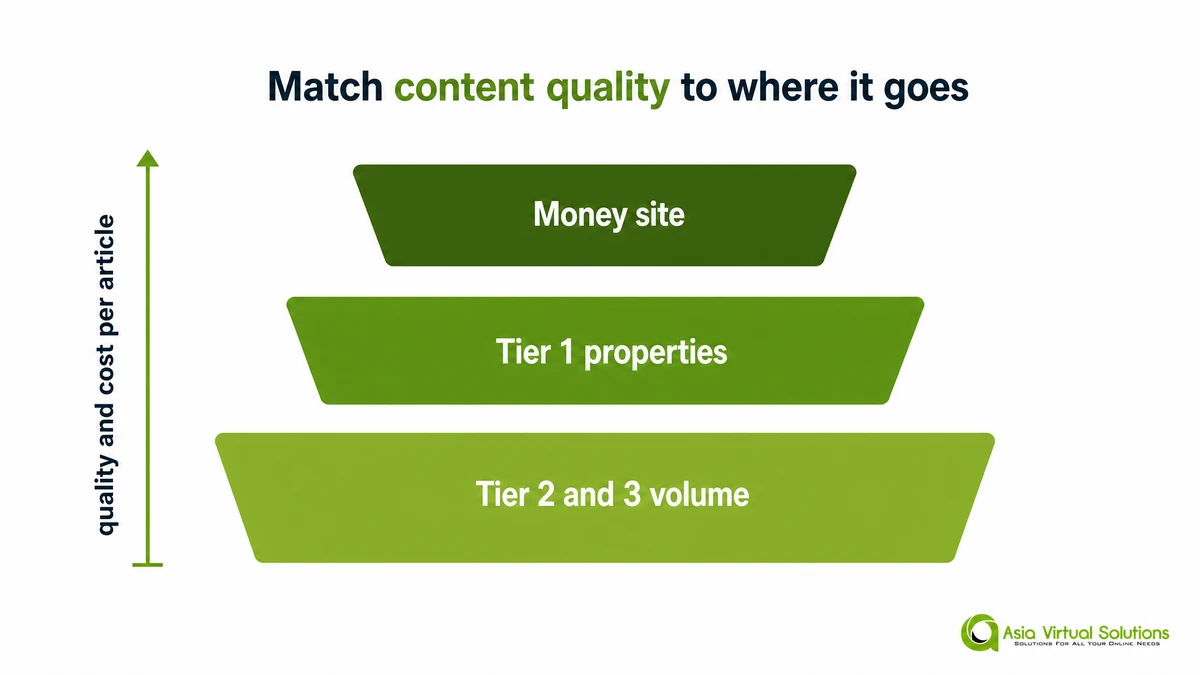
| Where it goes | Quality bar | Typical length | What matters most |
|---|---|---|---|
| Money site | Highest | 1,200 words and up | Accuracy, depth, an angle nobody else has |
| Tier one properties | Good | 500 to 800 words | Reads naturally, on topic, varied anchors |
| Tier two and three | Readable | 300 to 500 words | Volume, uniqueness, cost per piece |
On your money site every article does real work, so spend the most here. Tier one properties sit just below: web 2.0s, guest posts and branded profiles need content that reads properly, because a person may well look at it before it does its job. If you are still building early traffic, our guide on bringing traffic to a new website pairs well with this.
Then the volume layer. If you run GSA Search Engine Ranker campaigns you need a lot of readable, unique text and you need it cheap. The bar here is that it reads like English and is not duplicated, and paying for more than that is money you could have spent on tier one.
⚖️ Human writers or AI content
A few years ago this was an easy call. AI content was thin and repetitive, and anyone could spot it.
Not any more. Advanced AI technology now produces content that is properly structured, factually consistent, and hard to separate from human work.
The gap has closed for most content types, but not for all of them.
AI writers vs human writers compared
| Factor | AI article packs | Human writers |
|---|---|---|
| Cost per article | Low, scales with volume | High, scales linearly |
| Turnaround | Days for a full pack | Days to weeks per article |
| Volume capacity | Hundreds of articles at once | Limited by writer availability |
| Consistency of structure | Very consistent | Varies by writer |
| Languages | Several, same quality bar | Needs a native writer per language |
| First-hand experience | No | Yes |
| Original opinion or case studies | No | Yes |
| Best used for | Bulk pages, tier one, supporting content | Flagship pages, thought leadership |
A human still wins on anything needing first-hand experience or original opinion. Writing a case study about your own results, or a teardown of something you personally tested? Write it yourself, because the value is in the fact that you were there. For everything else, and especially for volume, AI content does the job at a fraction of the cost and time.
🚩 Red flags
Any one of these on its own is worth a question. Two or more together and you should look elsewhere.
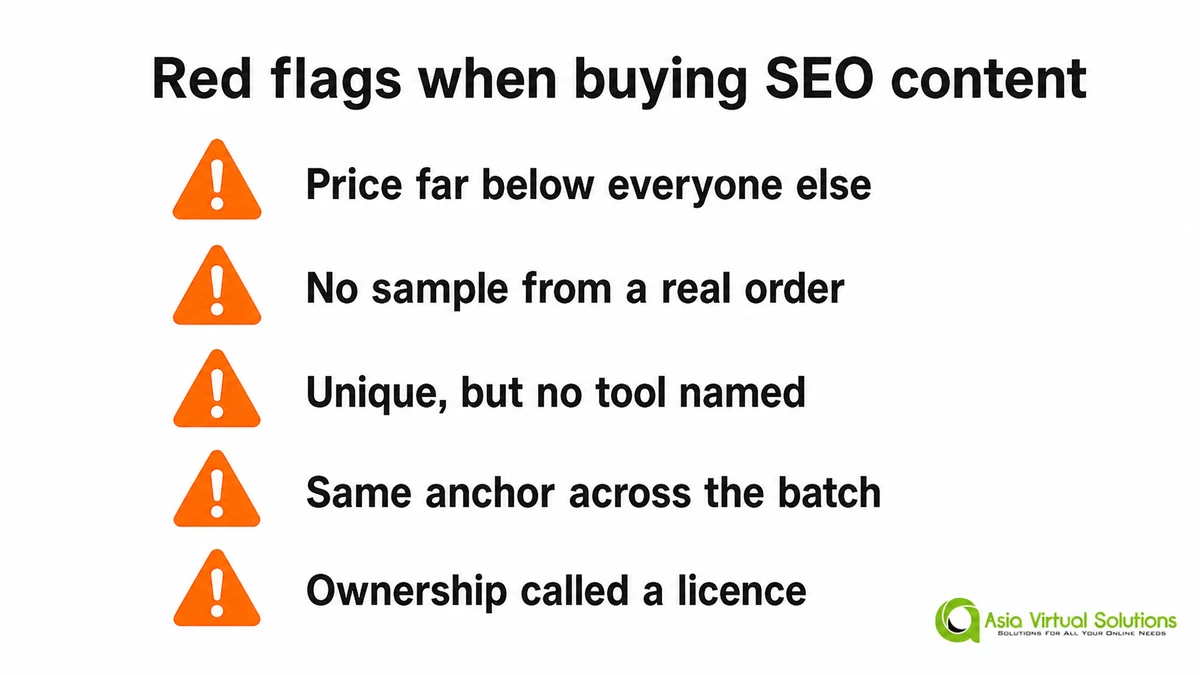
- A price far below everyone else with no explanation of how it is possible.
- No sample from a real past order, only polished examples written for the sales page.
- “100% unique” or “passes all checks” without naming a tool.
- No control over anchor text, or the same anchor used across an entire batch.
- Ownership described as a licence, usage rights, or anything short of outright transfer.
- Turnaround given as an adjective rather than a number of days.
- No revisions policy, or one that expires before you could reasonably have read the order.
📝 How to brief a service so you get what you wanted
Most disappointing orders are briefing failures rather than supplier failures. A topic on its own leaves every real decision to someone who does not know your campaign. Five lines fixes most of it.
- What the article has to achieve. Rank for a term, support a tier, fill a category page. This changes how it should be written.
- The primary keyword, plus two or three secondary terms. Secondary terms are what stop every article in a batch reading the same.
- Who the reader is. A page written for an agency buyer and one written for a beginner are different articles about the same subject.
- Anchor text and target URL, if the article is carrying a link.
- Word count, and anything to avoid. Competitor names, claims you cannot support, topics that are off-limits in your niche.
Write it once, save it, and reuse it for every order. Those five minutes decide more about the finished article than anything else you do.
🔧 How our AI-powered article packs work
You choose the topics or keywords and how many articles you need. Our system researches each topic and produces the article with proper H2 and H3 headings, bullet points, and tables where they suit the content. Every article is checked for originality before delivery.
Files arrive ready to publish, formatted the way they should already be, so there is no repair pass before they go live. Packs are available in several languages, so you can build in markets outside English without hunting for a writer in each one.
Ready to publish, not to rewrite
Get SEO-ready articles in bulk
Formatted, checked for originality, and available in the languages you need.
See the AI article packs
❓ Common questions
Are the articles unique?
Yes. Every article is written from scratch for your topic and checked for originality before we send it. You will not receive spun text, and we never resell the same article to another customer.
How long does an order take?
Most orders are delivered within a few days. Larger packs take a little longer because each article is produced and checked individually. You will get a delivery estimate when you place your order, so you can plan the rest of your campaign around it.
Can I choose the keywords?
Yes. You supply the topic or the target keyword for each article. If you only have a general subject in mind, tell us and we will work from that instead. Either way you stay in control of what each article is about.
What languages are available?
We produce articles in several languages besides English. Tell us which market you are targeting and we will confirm availability before you order. This matters if you build sites for non-English audiences, where most content services fall short.
Do I own the articles?
Yes. Once your order is delivered the content belongs to you. There is no licence, no attribution requirement, and no reuse by us. Publish them wherever you like.
Are the articles ready to publish?
Yes. They arrive formatted with headings, paragraphs, and lists, so you can paste them straight into your site. Most customers add their own images and internal links before publishing, but no rewriting is needed.
Will the content pass AI detection?
AI detectors are unreliable and often flag human writing too. Google has said it judges content on quality and usefulness, not on how it was produced. We focus on articles that are accurate, well structured, and useful to your reader.




 English
  简体中文
简体中文  Deutsch (Sie)
  Bahasa Indonesia
  Italiano
  日本語
日本語  한국어
한국어  Português do Brasil
  Русский
  Español de México
  ไทย
ไทย  Tiếng Việt
  Türkçe