



I often get approached by GSA Search Engine Ranker users who tell me they want to build only contextual or do-follow links, but they are not sure which engines to select to create them.
This post shows you how to create contextual do-follow backlinks in GSA Search Engine Ranker. Before we get to the settings, it helps to be clear on what contextual and do-follow links actually are.
Quick answer: how to build contextual do-follow links in GSA SER
- Start a new GSA Search Engine Ranker project as you normally would.
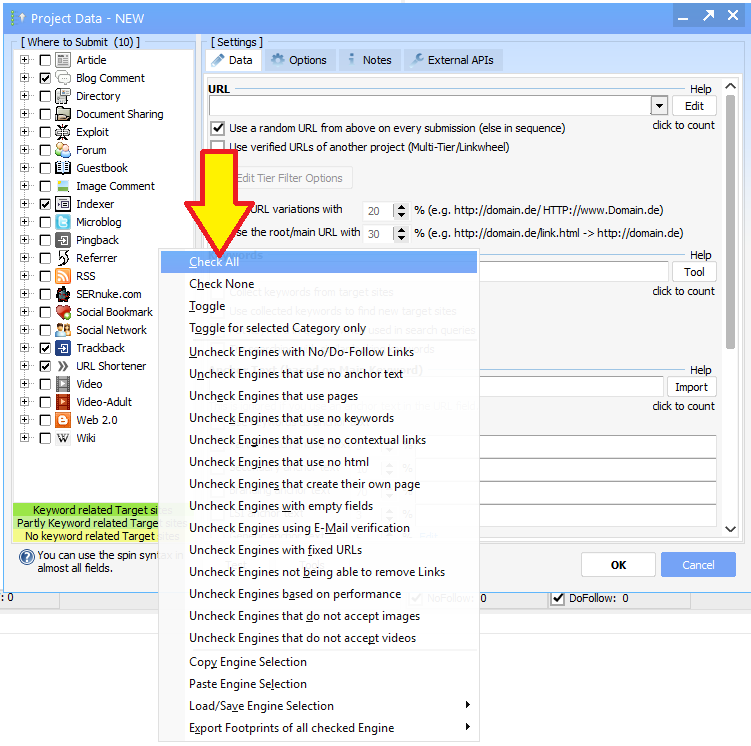
- Right-click in the engine list and choose Check All.
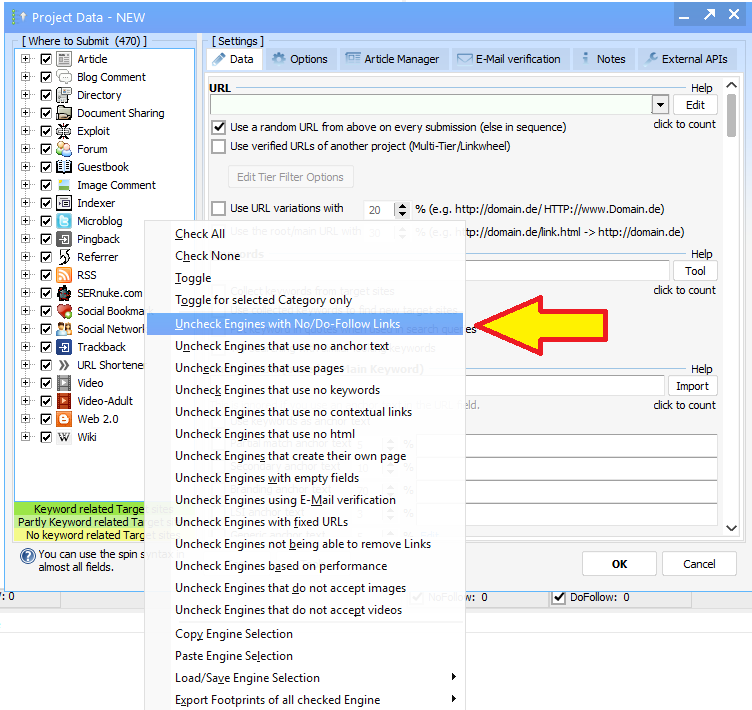
- Right-click again and choose Uncheck Engines with No/Do Follow, then select Uncheck Engines Creating and NoFollow Links.
- Right-click once more and choose Uncheck Engines that use no contextual links.
- Remove any remaining engines you do not want, then finish the project setup as usual.
A contextual link sits inside the body of an article, not in a footer or sidebar. A do-follow link is one that search engines are free to follow and count. GSA SER can filter for both in three right-clicks.
Contextual do-follow backlinks are links that appear inside the content of a page or blog post, pointing to another site such as yours, and they carry a share of that page’s authority with them. Here is the simple breakdown.
What Are Contextual, Do-Follow Backlinks?
Contextual Backlinks
These are links that are naturally included in the body of an article or a blog post. They are not in the footer or sidebar; they are woven into the main content where they make sense for readers.
For example, if a blog post is discussing “digital marketing tips” and it links to a page with more in-depth information on that topic, that is a contextual link.
Do-Follow Links
These are links that allow search engines to follow them and count them as “votes” towards the site they lead to.
When Google or another search engine sees a do-follow link pointing to your website, it treats it as a recommendation. It is a way of saying, “This is a trustworthy and relevant source,” which helps the linked site rank better in search results.
Why Contextual Do-Follow Backlinks Are Important
- Higher SEO value. Google sees these links as more relevant and more trustworthy because they are surrounded by related content. A link about SEO strategies inside an article on digital marketing is worth more than a random link on a page about cooking recipes.
- Improved rankings. Because do-follow backlinks signal to search engines that your site is credible, they can lift your position in the results. The higher the ranking, the more traffic and visibility your site gains.
- Natural traffic. Contextual links inside an article people are actually reading attract clicks from interested readers, which brings you visitors as well as ranking value.
Examples of Contextual Backlinks
Contextual backlinks carry extra power because they are naturally woven into relevant content. These links sit among related text, which makes them more valuable to readers and to search engines. Below are two examples.
Contextual Example 1
Imagine a marketing blog post titled “Top Digital Marketing Strategies for This Year.” In one paragraph it mentions, “One of the best tools for automating link building is GSA Search Engine Ranker.” If GSA Search Engine Ranker links to your product page, that is a contextual do-follow link.
Contextual Example 2
A health blog publishes an article on “Effective Ways to Handle Sleep Disorders.” Inside the content it links the phrase “natural sleep supplements” to a site selling them. The link is relevant to what the reader is already reading, so it counts as a quality contextual link.
Contextual do-follow backlinks work like a referral from someone you trust. When other reputable sites link to your content, you see better rankings on Google and other search engines, and your visibility improves.

Understanding Do-Follow and No-Follow Links
Links in SEO fall into two groups: do-follow or no-follow, depending on whether they pass authority to the linked website. The HTML below shows the difference.
Do-Follow Links
Most links are do-follow by default, meaning search engines will follow them and pass authority from one page to another. Because do-follow links can lift the linked page’s ranking, they are the ones link builders want.
Example code for a do-follow link
<a href="https://yourwebsite.com">Check out our SEO tools</a>There is no extra attribute on the link, which makes it a do-follow link by default.
No-Follow Links
A no-follow link asks search engines not to pass authority to the linked page. Site owners add it to links in comment sections, sponsored content and ads.
Example code for a no-follow link
<a href="https://yourwebsite.com" rel="nofollow">Check out our SEO tools</a>Nofollow is a hint now, not an instruction
This part matters, because most link building guides still describe the old behaviour. Google changed it in two steps. On 10 September 2019 the link attributes became hints for ranking purposes, and on 1 March 2020 nofollow became a hint for crawling and indexing as well. Google may now choose to take a nofollow link into account, or ignore it. You no longer control that from the page.
Google also added two more specific attributes at the same time:
rel="sponsored"for paid, affiliate and sponsored links.rel="ugc"for user-generated content such as comments and forum posts.rel="nofollow"for everything else you do not want to endorse.
One more thing worth knowing: nofollow has never been a way to keep a page out of the index. If you need a page kept out of search results, use a noindex tag. We cover this in more detail in our guide on what value nofollow links have in SEO.
Knowing the different link types lets you control your own site’s link profile by deciding which links pass value and which do not.

How To Create a Contextual, Do-Follow Project in GSA Search Engine Ranker
Building contextual do-follow backlinks is a core part of most link building campaigns, and GSA Search Engine Ranker lets you automate it. Select your platforms carefully and filter for do-follow, contextual links, and you build the kind of links that lift a site’s authority.
Combine these GSA Search Engine Ranker projects with other methods such as guest posting and data-driven content, and you diversify your backlink profile at the same time.
Selecting the GSA Search Engine Ranker platforms
Start a GSA SER project as you would normally do, but this time right-click anywhere in the platform area and select Check All, as shown in the screenshot below.
Remove the engines that do not create do-follow links
Now that every platform in GSA Search Engine Ranker is checked, start removing the ones you do not want, beginning with every engine that does not create do-follow links. Right-click in the platform area again and select Uncheck Engines with No/Do Follow.
In the next window, select Uncheck Engines Creating and then NoFollow Links below it.
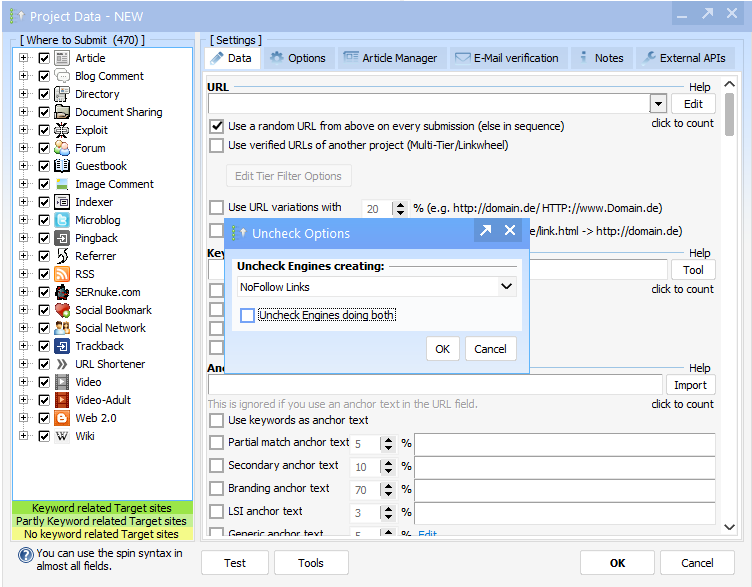
This automatically unchecks every engine or platform that creates no-follow links.
You will also see a checkbox for Uncheck Engines doing both. Some sites give you both do-follow and no-follow links. If you want to be strict, tick that as well, and you will only be left with engines that produce do-follow links.
That completes the first part. Next we remove the engines that do not create contextual links.
Remove the engines that do not create contextual links
We have checked every engine and removed the ones that build no-follow links. The next step is to remove the engines that do not build contextual links.
Right-click again in the platform area, and this time select Uncheck Engines that use no contextual links, as shown below.
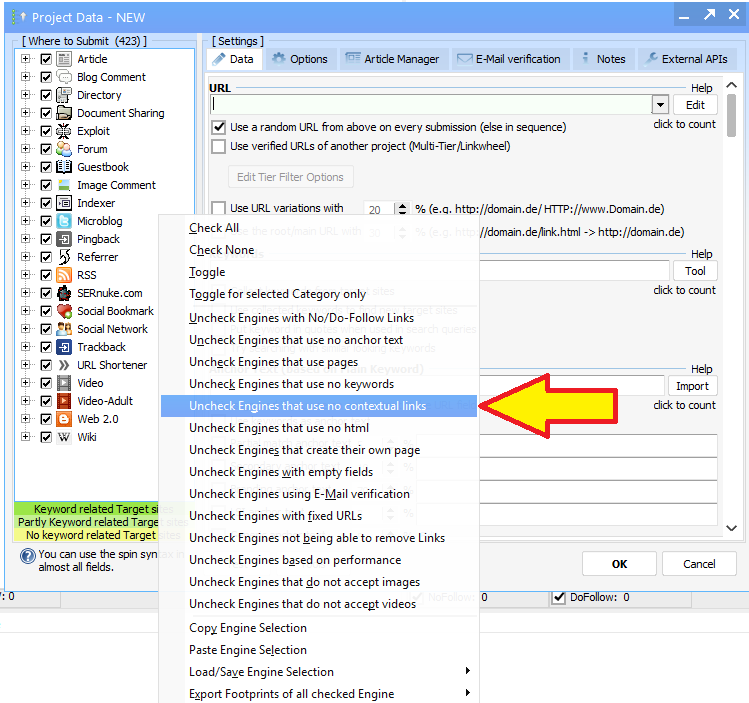
That is the engine selection done. Your project will now only build links on sites that offer do-follow contextual links.
You can remove any other engines you do not want at this point, such as the adult engines, and then finish the rest of your GSA project as you normally would.
Frequently Asked Questions About Do-Follow Contextual Backlinks
What are contextual do-follow backlinks?
Contextual do-follow backlinks are links placed inside relevant content that pass ranking value to the site they point at. They appear naturally within articles or blog posts where the surrounding text relates directly to the linked page.
How do contextual do-follow backlinks differ from other types of links?
Unlike standalone footer or sidebar links, contextual do-follow backlinks sit inside related content. They carry more weight because they give the reader a relevant resource at the point where it is useful, rather than sitting in a list of links nobody reads.
What makes a backlink contextual?
A backlink is contextual when the surrounding text relates to both the anchor text and the page being linked to. The link should fit naturally inside the paragraph and give the reader somewhere useful to go next.
Why do search engines value contextual do-follow links?
Search engines read a contextual do-follow link as a recommendation, because it appears inside content on the same subject. That placement suggests the link is there to help the reader rather than purely to promote the destination.
How can websites earn contextual do-follow backlinks?
Through content partnerships, guest posting, resource mentions, and publishing something other people want to reference. The methods further down this page cover ten of them in detail, including guest posting, broken link building and data-driven content.
What role does anchor text play in contextual backlinks?
Anchor text tells search engines what the linked page is about. Natural, varied anchor text strengthens the connection between the two pages. Our GSA SER anchor text guide covers how to split the seven anchor fields so the profile looks natural.
Are all contextual backlinks do-follow by default?
No. A site can make any contextual link do-follow or no-follow. Do-follow links pass ranking value; no-follow links send traffic but ask search engines not to pass value, and since March 2020 that request is treated as a hint rather than an instruction.
What industries benefit most from contextual do-follow backlinks?
Any industry benefits, but those with information-rich content gain the most, because there is more relevant text for a link to sit inside. Technology, education, finance and professional services are typical examples.
How many contextual do-follow backlinks should a website aim for?
There is no target number, and anyone quoting one is guessing. Quality and relevance matter more than volume. What is measurable is the other direction: Ahrefs found that of roughly 20 million pages with no referring domains at all, only 2,997 get more than 1,000 monthly search visits.
Can contextual do-follow backlinks harm website rankings?
Poor-quality or irrelevant links can. Links should come from sites that make sense for your subject, sit in relevant content, and be useful to a reader who clicks them. Building a large number of links from unrelated sites is the pattern to avoid.
Contextual Do-Follow Backlink Statistics
There are a lot of backlink percentages circulating that no study supports. The figures below are the ones that can actually be traced to published research, with the source and date next to each so you can check them yourself.
| What the data shows | Figure | Source |
|---|---|---|
| Pages that get no organic traffic from Google at all | 96.55% of around 14 billion pages | Ahrefs, December 2023 |
| Pages that get between one and ten visits a month | 1.94% | Ahrefs, December 2023 |
| Pages with no referring domains that still pass 1,000 monthly visits | 2,997 out of ~20 million, about 1 in 6,671 | Ahrefs, December 2023 |
Share of backlinks that carry rel="nofollow" | 10.6% | Ahrefs, study of 110,000 sites, May 2020 |
| Sites using nofollow on some internal links | 35.3% | Ahrefs, May 2020 |
| Nofollow became a ranking hint rather than a directive | 10 September 2019 | Google Search Central |
| Nofollow became a hint for crawling and indexing too | 1 March 2020 | Google Search Central |
What this adds up to is simple enough. Most pages on the web get no search traffic, and pages with no links pointing at them almost never break out of that group. That is the case for building links. It is not a case for any particular percentage, and you should be sceptical of anyone who gives you one.
External Resources on Contextual Do-Follow Backlinks
Every link below was checked in September 2026. The first two are Google’s own documentation, which is the only source that speaks for Google.
- Google Search Central – how to qualify outbound links with
nofollow,sponsoredandugc, and what each one means. - Google Search Essentials – the spam policies, including the section on link spam.
- Ahrefs – the study of ~14 billion pages behind the traffic figures in the table above.
- Ahrefs – nofollow links explained, with the data on how widely the attribute is used.
- Moz – reference guide on backlink types and their effect on rankings.
- Moz – how anchor text works and why variety matters.
- Backlinko – methods for earning editorial links.
- Search Engine Land – link building and how search engines weigh links.
- Search Engine Journal – current standards for acquiring links.
- Yoast – implementing link structures and attributes correctly.

Alternative Ways to Obtain Contextual Do-Follow Links
While GSA Search Engine Ranker is an excellent tool for building contextual do-follow backlinks, it is not the only method. Below are ten alternatives worth having in the mix.
How to build contextual backlinks through guest posting
Guest posting remains a reliable method for building contextual backlinks. Identify relevant sites in your niche that accept guest posts, then read their guidelines and a few of their published pieces to understand the style. Write original content that carries your target anchor text naturally. Pitch site owners personally, mention what you can cover that they have not, and follow up once. Keep the relationships going, and spread your targets across several sites so the profile looks natural.
How to find link opportunities with the broken link method
The broken link method finds dead links on authority sites and offers a replacement. Use a tool such as Ahrefs or Check My Links to spot broken links on relevant pages. Create content that could sit in place of the dead resource. Contact the site owner, tell them about the broken link, and suggest your page. It works because you are fixing a problem for them at the same time as earning the link.
How to create resource pages that attract contextual backlinks
Resource pages attract links by pulling everything on a topic into one place. Research the subjects people in your industry keep searching for, then build detailed guides or lists that become the obvious page to cite. Include data and specifics so there is a reason to reference you. Organise it clearly, share it with people in the industry, and keep it updated so it stays worth linking to.
How to earn contextual backlinks with data-driven content
Original data attracts links from sources you could never reach with an outreach email. Run a survey, analyse a trend, or compile numbers nobody has published. Present the findings as charts and a clear write-up, and include a methodology section so people trust the figures. Then contact the publications that cover your industry. Make the data easy to cite, with attribution guidelines stated on the page.
How to secure contextual backlinks through journalist request platforms
Answering journalist queries earns links from news sites and industry publications, often with a contextual mention in the body of the article.
If you have read about this method before, you have probably seen it described as HARO. Help a Reporter Out closed permanently on 9 December 2024, along with Connectively, the platform Cision replaced it with. Any guide still telling you to sign up for HARO was written before that. These platforms are live and do the same job:
- Qwoted – the most direct HARO replacement, with a free tier for sources.
- Featured – expert questions from publishers, answered in writing.
- SourceBottle – strongest in the UK and Australia.
- Muck Rack – a paid platform, aimed at PR teams rather than individuals.
The approach is the same whichever you use. Monitor the queries in your field, answer quickly, give a real answer rather than a plug, state your credentials, and follow the journalist’s requirements exactly.
How to build contextual backlinks through podcast interviews
Podcast appearances create links in show notes and transcripts. Find the podcasts your customers already listen to, then pitch the hosts with specific talking points rather than a general offer to appear. Prepare a few stories and numbers worth hearing. Ask for the show notes to include a link to the resource you mention on the episode, and share the episode afterwards so the host has a reason to have you back.
How to generate contextual backlinks with skyscraper content
Skyscraper content improves on a page that already earns links. Find the popular content in your niche, then build a better version with current information, deeper detail or clearer presentation. Contact the sites linking to the original and show them what yours adds. Track the outreach so you can see which angles get replies.
How to acquire contextual backlinks through industry partnerships
Partnerships create link opportunities that do not feel like link building. Find businesses in complementary industries, then work on something together: a joint guide, a webinar, a piece of research. Co-branded resources give both sides something to promote and a natural reason to link. These relationships keep producing opportunities long after the first project.
How to earn contextual backlinks through expert roundups
Roundups earn links because the contributors promote them. Pick a question people in your industry actually argue about, invite respected names to answer it, and publish everything in one piece. Make it easy for contributors to share, with ready-made quotes and images. Thank everyone who took part, and refresh the piece when the answers start to date.
How to build contextual backlinks through case studies
Case studies attract links because they show a real result rather than describing a method. Document a project properly: the starting position, what you did, the numbers, and what you would do differently. Be specific about the methodology. Share the finished study with industry publications, and update it when you have newer results.

Conclusion
Building contextual do-follow backlinks is a core part of most SEO campaigns, and GSA Search Engine Ranker automates the slow part of it. Select your platforms carefully, filter for do-follow and contextual engines with the three right-clicks above, and the project will only build on the sites you actually want.
Combine those projects with the other methods on this page, and you end up with a backlink profile that has both volume and variety behind it.
Want the project set up for you?
If you would rather skip the engine selection and the testing, we build GSA Search Engine Ranker projects for you, with the platforms filtered, the data packs loaded and the anchor text already set up.






 English
  简体中文
简体中文  Deutsch (Sie)
  Bahasa Indonesia
  Italiano
  日本語
日本語  한국어
한국어  Português do Brasil
  Русский
  Español de México
  ไทย
ไทย  Tiếng Việt
  Türkçe