


Most of the GSA Search Engine Ranker advice still floating around forums and YouTube was written for a version of search that no longer exists. It was written when a backlink was a backlink, when link velocity was the headline metric, and when the fastest way to move a page was to point everything you had at it.
That advice is old. The tool is not.
GSA Search Engine Ranker has not become obsolete. What has become obsolete is treating every backlink, every platform, every content type and every tier as if they all do the same job.
The old mindset
More submissions → more backlinks → higher rankings.
The 2026 mindset
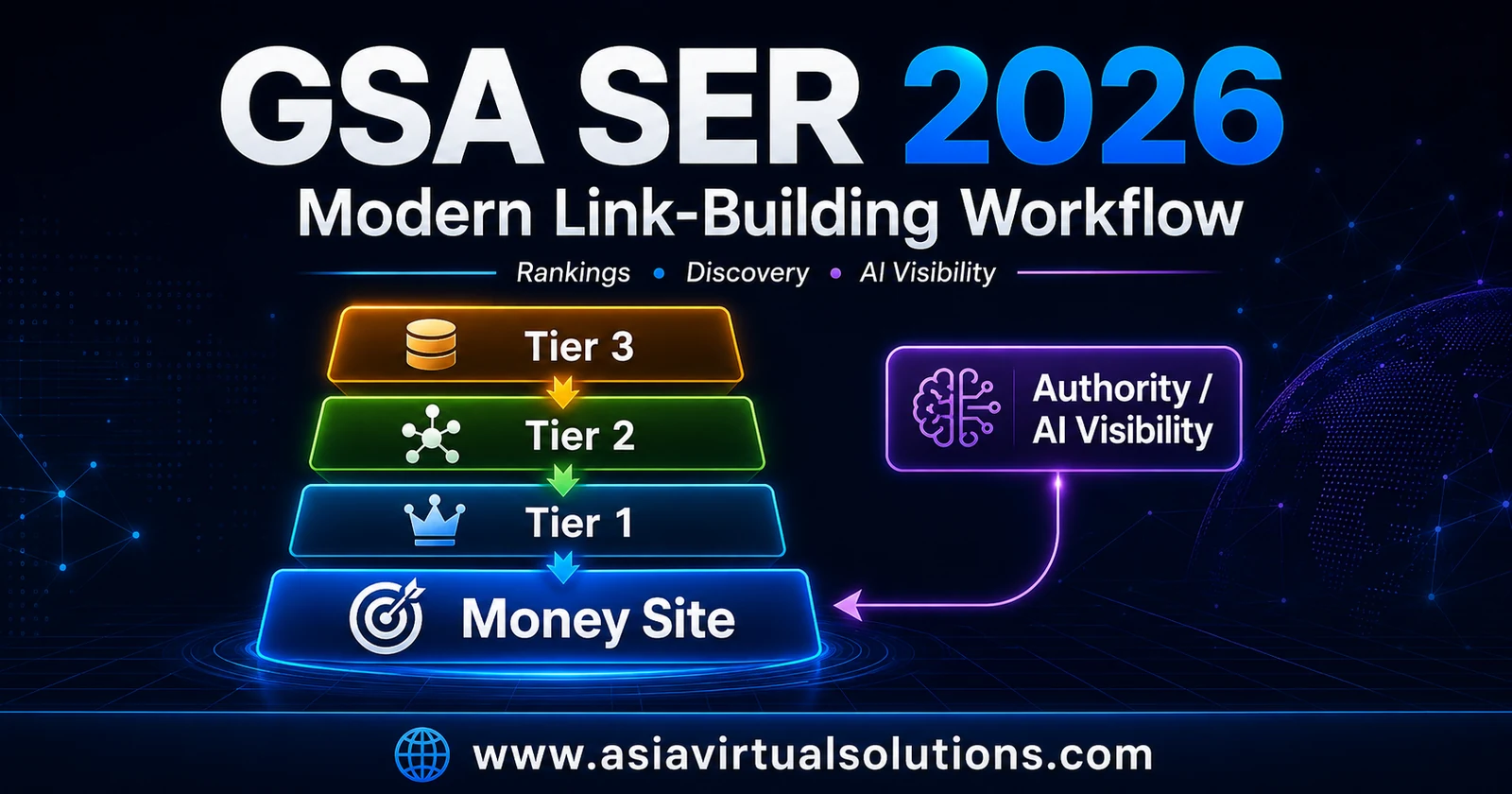
Better Tier 1 → diversified Tier 2 → scalable Tier 3 → a stronger overall link graph.
Plus: authority content → broader search, entity and AI discoverability.
The practical difference is how you think about the software. GSA SER works best as an automation engine sitting inside a planned architecture. It works worst as a machine that fires every available engine at your money site and hopes something sticks.
This article breaks the whole thing down layer by layer, with the platform types, anchor ratios, velocity ranges and content rules that belong at each level. You will also get a worked example, a launch checklist and a list of the mistakes that still cost people the most money.
The 2026 GSA SER Link-Building Workflow at a Glance
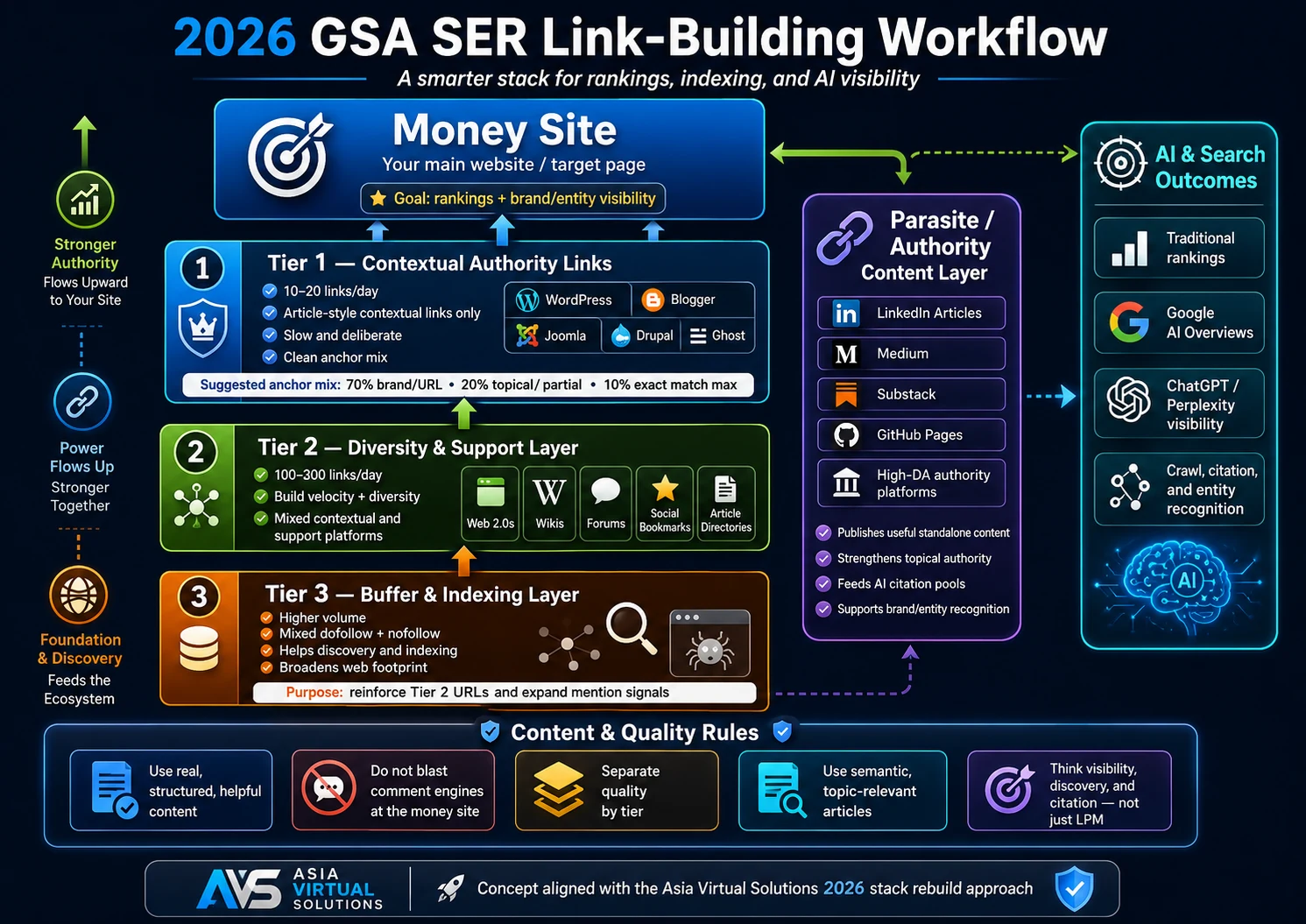
A modern GSA SER campaign separates links according to their job. Quality and control increase as the links get closer to the money site, while scale and diversity increase deeper in the support layers.
That single sentence is the whole strategy. Everything below is detail.
Google policy note: Google classifies links created primarily to manipulate search rankings, including links created using automated programs or services, as link spam. This workflow describes how experienced GSA SER users structure automated campaigns and manage quality and risk. It should not be read as a Google-endorsed link-building method.
The Core Ranking Stack
The main structure runs in one direction:
Tier 3 → Tier 2 → Tier 1 → Money Site
Read those arrows as “points at”. Tier 3 links point at Tier 2 URLs. Tier 2 links point at Tier 1 URLs. Selected Tier 1 links point at your money site.
Nothing from Tier 2 or Tier 3 goes anywhere near the money site in this model. That is not a rule handed down by Google. It is a design decision that gives you control over what sits directly next to the page you actually care about.
The Authority / Visibility Path
Beside the tier stack sits a second, separate path: Authority Content → Money Site, and more loosely, Authority Content → Wider Search, Entity and AI Discovery.
This layer is not another disposable tier. Authority content should be publishable on its own merits: a real article on an established third-party platform that could be found, read and linked to even if it never sent you a single visitor.
Tier links exist to support a structure. Authority content exists to be found.
Quick Tier Comparison Table
| Layer | Primary purpose | Typical scale | Primary target |
|---|---|---|---|
| Money Site | Ranking and conversion destination | — | — |
| Tier 1 | Contextual authority and relevance | Low / controlled | Money site |
| Tier 2 | Diversity and reinforcement | Medium | Tier 1 |
| Tier 3 | Discovery and scalable support | High | Tier 2 |
| Authority Layer | Topic, brand and entity presence | Selective | Money site + wider ecosystem |
One clarification before anyone screenshots that table: low, medium and high are relative to your own campaign. They are not universal numbers. A 12-page local business site and a 400-page affiliate site will produce completely different figures from the same framework.
Quality Should Increase Closer to the Money Site
The simplest way to remember the whole architecture:
- Tier 1 = maximum control
- Tier 2 = more diversity
- Tier 3 = more scale
- Authority layer = high-value standalone content
Power flows upward, while visibility spreads outward.
Tier 3 feeds Tier 2. Tier 2 feeds Tier 1. Tier 1 feeds the money site. That is power flowing upward through the stack. Meanwhile the authority layer pushes sideways into places your own domain cannot reach on its own. Neither path replaces the other.
Content Quality Is Part of Link Quality
The old approach treated content as packaging. You needed some words around the anchor, so you spun an article, generated 400 variations and moved on.
A modern approach looks at the whole context surrounding the link:
- topical relevance to the target page
- semantic meaning, not just keyword presence
- readable headings
- information a human could actually use
- entity relationships (brands, places, products, people)
- natural anchor placement inside a sentence
Old model: one spun article → hundreds of near-identical variations.
Modern model: meaningfully different articles on the same broad topic, each covering a different question, angle or entity combination.
The second approach is not slower any more. AI content generation removed most of the cost that made spinning attractive in the first place. If you are still relying on heavy spintax, you are paying an SEO penalty for a saving that no longer exists.
A Practical Example of the Complete Stack
Fictional example, used strictly to show link architecture. Say the business is Austin Testosterone Replacement Clinic and the page you want to rank is example.com/testosterone-replacement-austin/.
Money site. The main service page. It has to be worth ranking before anything else matters.
Tier 1 (contextual, controlled). Three to five article-style placements on quality contextual platforms, each a real piece of writing:
- Understanding Low Testosterone Treatment Options in Austin
- What Men Should Know Before Starting TRT
- Questions to Ask a Testosterone Therapy Provider
Anchors across these are diversified, weighted heavily toward the brand name and the naked URL.
Tier 2 (diversity). Web 2.0 properties, wikis, forums, social bookmarks and article platforms pointing at the three Tier 1 URLs above. Not at the clinic’s website.
Tier 3 (scale). Higher-volume supporting links pointing at the Tier 2 URLs, widening the crawl paths into the whole structure.
Authority content. One substantial standalone article on an established third-party platform, something like A Practical Guide to Testosterone Replacement Therapy in Austin, written to be read rather than written to hold a link.
This example demonstrates architecture only. A real campaign in a health-adjacent niche carries its own editorial and compliance considerations that sit outside the scope of link building.
Why GSA SER Still Matters in 2026
GSA Search Engine Ranker still matters because automation itself was never the problem. Its value is the ability to automate large amounts of repetitive link-building work while giving you control over platforms, filters, tiers, anchors and project structure.
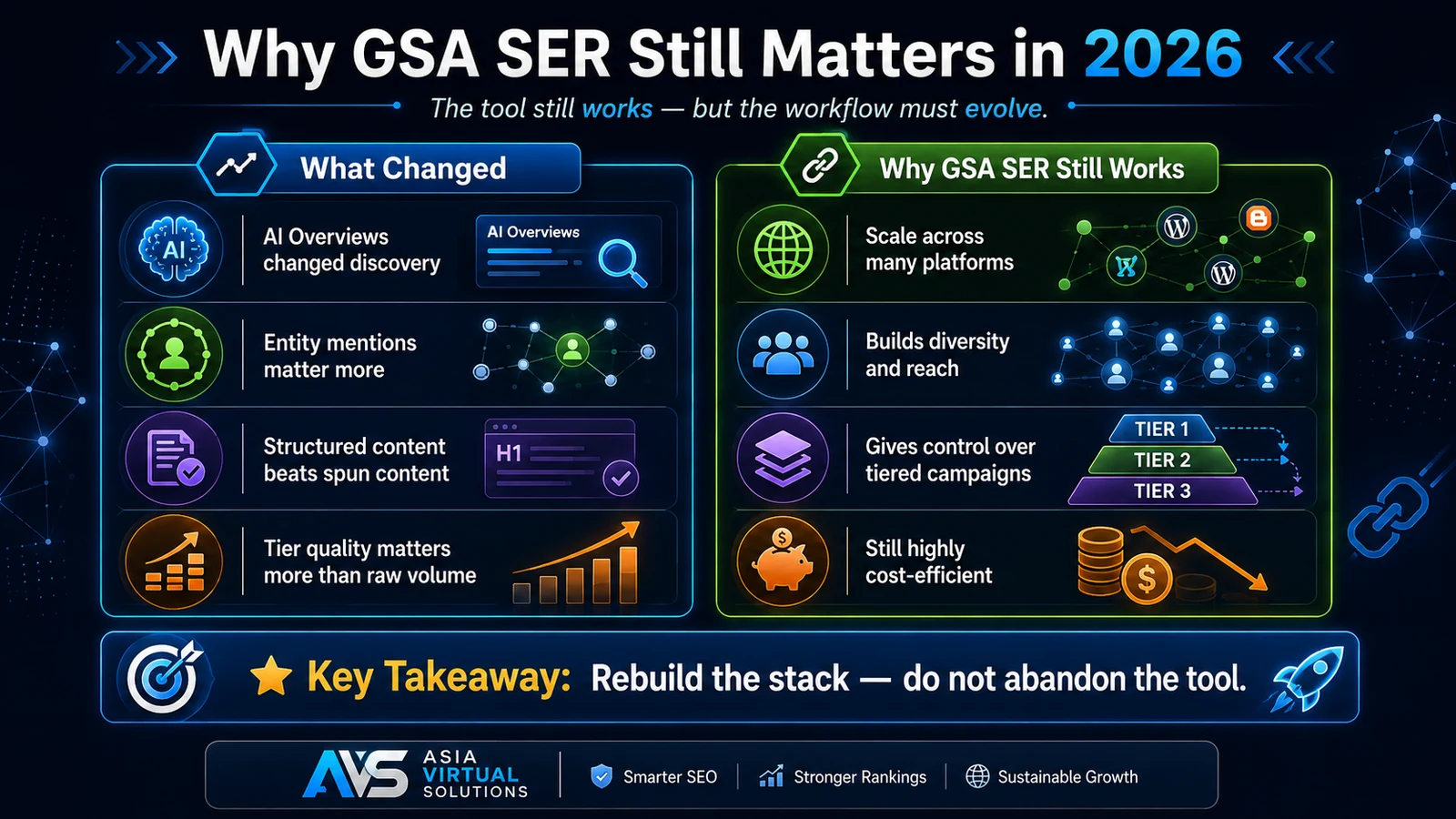
What Changed?
Quite a lot, and most of it sits on the interpretation side rather than the link side.
- Google AI Overviews. AI Overviews and other AI search experiences now appear across many search queries, which changes what a top-ten position is worth. Google says these features surface supporting links to web pages alongside the generated answer.
- Semantic search. Search engines evaluate meaning and topic coverage, not just keyword matching.
- Entity understanding. Brands, people, products and locations are recognised as things, and the relationships between them carry weight.
- Content evaluation. Thin, near-duplicate pages have a harder time surviving long enough to pass anything on.
- Retrieval-based AI systems. AI search and retrieval systems can use information from public web sources when web retrieval is involved. OpenAI says ChatGPT responses that use search may include inline citations to the pages behind them. Being present and consistent across the open web now has a second audience.
- Diminishing returns on raw volume. Chasing maximum link count for its own sake produces a worse cost-per-useful-placement than it did five years ago.
None of that means links stopped counting. It means the quality of the environment around the link now does more work than it used to.
What Has Not Changed?
Links may still contribute to:
- discovery of new URLs
- crawl paths through your site and its supporting structure
- authority transfer in conventional search contexts
- topical relationships between pages
- URL-to-URL relationships across a link graph
- referral traffic
- rankings
The takeaway is not “stop building links.”
Use different kinds of links for different jobs.
Why GSA SER Is Still Useful
Stripped of hype, here is what the software actually does well:
- broad platform coverage across hundreds of engine types
- unattended automation once a project is configured
- granular project filters (language, country, outbound links, keyword filters)
- anchor-text groups that let you control ratios per project
- scheduling and pausing
- native tiered projects, where one project automatically links to another project’s verified URLs
- content submission across many platform formats
- project cloning and template reuse
- scalable target discovery through scraping and imported lists
- fast creation of support links at a volume no human would attempt manually
That last point is the one people forget. Nobody is hand-building 40,000 Tier 3 links. Either automation does it or it does not get done.
If you want the platform-by-platform engine selection detail behind this, our companion piece on rebuilding your GSA SER stack around AI Overviews covers the exact filtering process inside the GSA SER interface.
10 Mistakes to Avoid With GSA SER in 2026
- Sending every available platform directly to the money site. This is the single most common configuration error. It puts guestbooks and blog comments in the same position as your best contextual placements.
- Using the same content quality on every tier. Your Tier 1 article and your Tier 3 filler should not come from the same generator with the same settings.
- Obsessing over links per minute instead of useful verified placements. LPM measures how fast the software submits. It does not measure whether anything survived. We covered this in detail in why chasing LPM and VPM is the wrong target.
- Overusing exact-match anchors. Still one of the fastest ways to make an otherwise fine link profile look manufactured.
- Applying identical anchor ratios to every tier. Tier 1 needs restraint. Tier 3 can be far looser without the same exposure.
- Ignoring the content surrounding the backlink. The page hosting your link is evaluated too. Unreadable text weakens the placement.
- Building Tier 2 without intentionally supporting Tier 1 URLs. If Tier 2 is not aimed at your verified Tier 1 list, it is just noise pointing at nothing you care about.
- Creating backlinks but never checking whether they survive. Verified at submission is not the same as alive in three weeks. Re-verify.
- Rejecting every nofollow placement simply because it is nofollow. More on this below, but a link profile made entirely of followed links is its own kind of unnatural.
- Treating AI visibility as a replacement for conventional SEO. It is an additional surface, not a substitute. Your page still has to be indexable, useful and findable the old way.
Tier 1: Contextual Authority Links
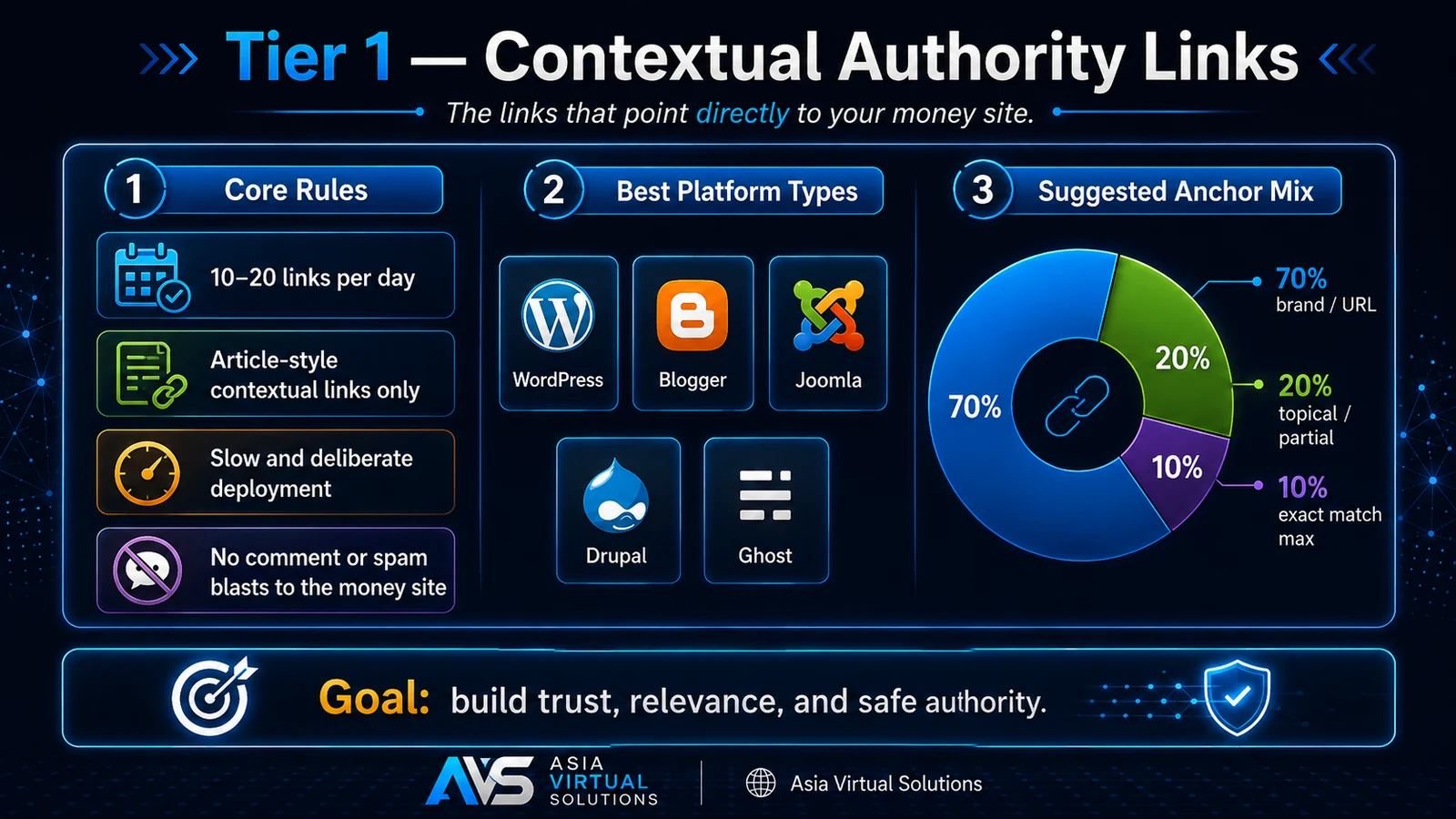
Tier 1 contains the backlinks that point directly to the money site, so it should normally be the most controlled part of an automated campaign.
The Goal of Tier 1 Is Control, Not Maximum Volume
Tier 1 is not the dumping ground for every engine GSA SER can reach. It is the shortlist.
Think about it from the other direction. If someone examined the links pointing at your money page, Tier 1 is the entire visible surface. Everything you allow into that layer is a statement about the site.
The closer a backlink sits to the money site, the more selective you should be. That is the whole principle, and it is the one that most campaigns get wrong.
Recommended Tier 1 Platform Types
Platform categories that generally suit Tier 1:
- article-style engines
- quality Web 2.0 properties
- contextual CMS platforms
- WordPress
- Blogger
- Joomla
- Drupal
- Ghost
- established article publishing platforms
One caution. Being built on WordPress or Drupal does not make a target good. Those are platform types, not quality guarantees. A neglected WordPress install with 900 outbound links on the page is a poor Tier 1 placement regardless of what it runs on.
What is actually available to you changes with your verified list, your niche and the time of year. If you want a starting point that is already filtered, our verified GSA SER link lists are updated continuously, and there is a case for not relying on a verified list alone that is worth reading before you commit to one approach.
What Should Usually Stay Away From the Money Site?
These categories are generally better placed deeper in the stack:
- blog comment engines
- trackbacks and pingbacks
- low-value profile links
- guestbook-style links
- indiscriminate forum posting
- placements on completely unrelated topics
To be clear about what this does and does not say: none of these categories are worthless. Several of them are useful for discovery and for widening a link graph. The issue is where you use them in the architecture. A blog comment pointing at a Tier 2 Web 2.0 property does a job. The same comment pointing at your money page does a different and less helpful job.
Suggested Tier 1 Anchor Framework
The infographic uses a simple starting split:
| Anchor type | Starting share | Examples |
|---|---|---|
| Brand, URL and naked domain | 70% | Austin TRT Clinic, example.com, https://example.com/ |
| Topical, partial-match and related | 20% | testosterone therapy in Austin, TRT clinic options |
| Exact match | 10% maximum | testosterone replacement Austin |
Treat that as a starting framework, not a mathematical rule. There is no anchor ratio that is correct for every site.
What should actually influence your ratios:
- your current backlink profile and what it already over-uses
- site age and how established the brand signals are
- niche norms (some verticals are naturally anchor-heavy)
- competitive landscape for the target phrase
- your existing exact-match percentage across all referring domains
- what the target page is for
If you want the more granular version of this split, including how to divide generic and naked-URL anchors separately, we break it down further in the 2026 stack rebuild article and in our anchor text optimisation guide.
Tier 1 Content Quality
Tier 1 content should ideally:
- answer a real question someone might type
- stay topically coherent from start to finish
- use headings a human can scan
- include relevant entities (brand names, locations, product names, related concepts)
- avoid keyword stuffing
- avoid unreadable spintax output
- make sense as an independent page, with the link removed
- place the backlink naturally inside a sentence, not bolted onto the end
This is where AI content earns its place, provided you use it properly. Generating fifty distinct articles about the same topic, each approaching it from a different angle, produces a far better Tier 1 footprint than generating one article and spinning it fifty ways. The difference is not the technology. It is whether you are creating variety or manufacturing duplication.
Our contextual do-follow link guide walks through configuring GSA SER to target the platform types that support this kind of content.
Tier 1 Velocity
The infographic shows 10 to 20 links per day as an example of a controlled Tier 1 model.
That number is an illustration, not a prescription. Publish it as a rule and someone will apply it to a ten-year-old authority domain and a two-week-old affiliate site with equal confidence, and one of them will be wrong.
Things that should move that number:
- how long the site has existed and its link history
- how many distinct target pages the campaign covers
- current backlink velocity from all sources, not just GSA SER
- niche and competitor link behaviour
- how many actually good targets your list contains
- your own risk tolerance for the property
Slow and deliberate is the default for Tier 1. If you are unsure, build fewer.
Tier 2: Diversity and Support
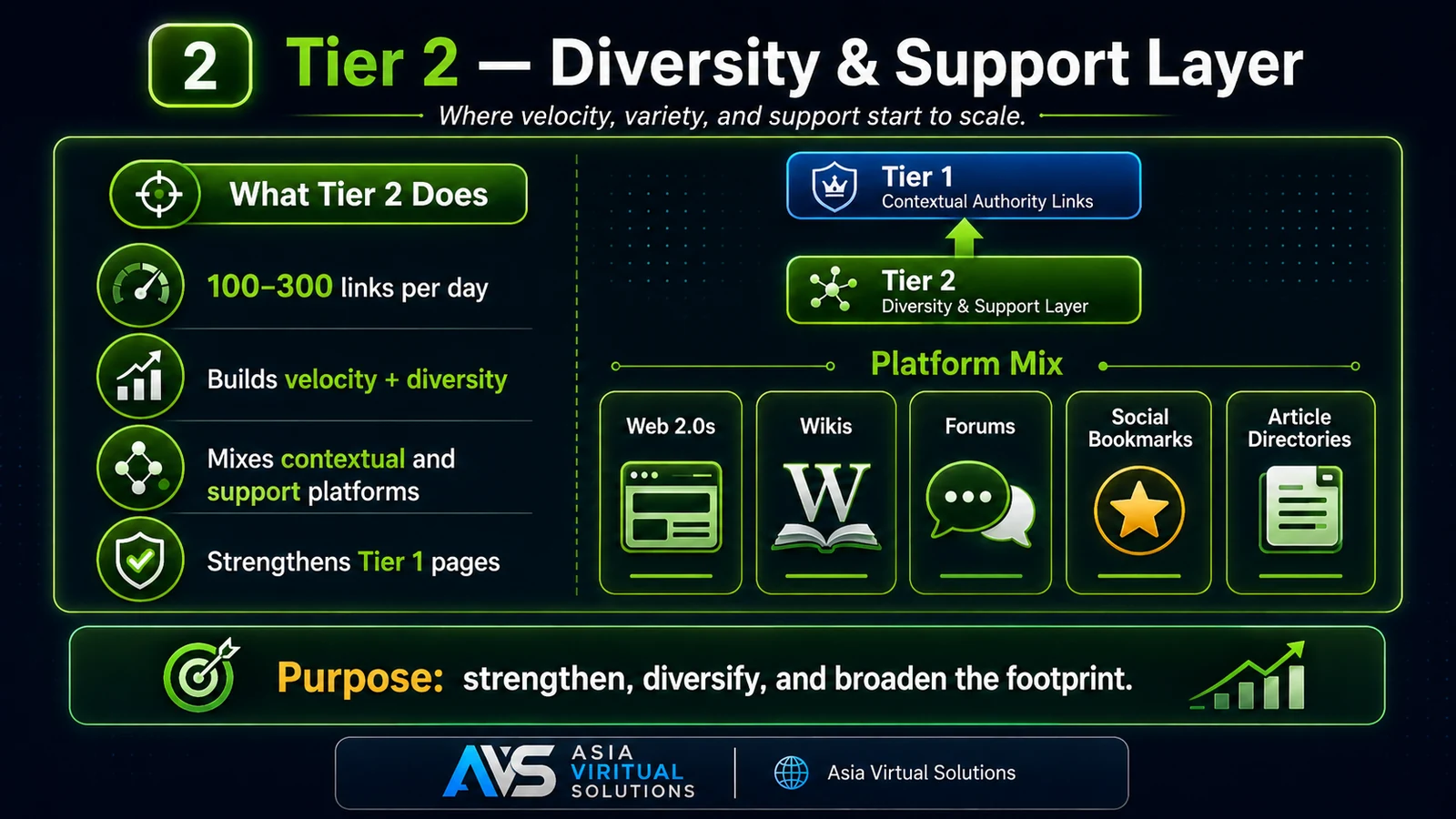
Tier 2 normally points at Tier 1 rather than the money site. Its job is to strengthen Tier 1 URLs, create additional discovery paths and introduce more platform and anchor diversity into the campaign.
What Tier 2 Should Accomplish
- Reinforce Tier 1 URLs. A Tier 1 article with no links pointing at it is a page nobody visits and crawlers rarely revisit.
- Increase platform diversity. More engine types, more footprint variety, less of a single repeated pattern.
- Increase crawl and discovery paths into Tier 1 content. More routes in means more chances the Tier 1 page gets found and re-crawled.
- Broaden anchor variety. Tier 2 anchors can be much looser than Tier 1 anchors, because they are not describing your money page.
- Support the Tier 1 pages that deserve it. Not every Tier 1 URL is worth the same investment.
Suitable Tier 2 Platform Mix
- Web 2.0 properties
- wikis
- forums
- social bookmarks
- article directories
- contextual profiles
- general content platforms
Tier 2 tolerates far more variety than Tier 1 for one reason: it does not touch the money site in this architecture. That single degree of separation is what buys you the freedom to experiment.
If you want a stronger foundation under this layer, hand-built Web 2.0 posts on DA50+ properties sit well at the top of Tier 2, particularly when they support your most important Tier 1 URLs.
Tier 2 Velocity
The visual uses 100 to 300 links per day as an illustrative range. Again, this is a campaign observation, not a ranking formula. Nothing happens at 301.
Real Tier 2 scale is determined by:
- how many Tier 1 URLs you have to support
- the size of the overall campaign
- target availability in your lists
- verified list quality and freshness
- proxy resources
- CAPTCHA solving capacity
- how many email accounts you have available
- observed success rates on the platforms you are hitting
- niche
Three of those are resource limits rather than strategy decisions. If your Tier 2 is underperforming, check the plumbing before you change the plan: proxies, CAPTCHA solving and email accounts are the three that quietly cap most campaigns. Running the whole stack on an underpowered machine has the same effect, which is why a dedicated GSA SER VPS tends to pay for itself once you are running multiple tiered projects.
When to Promote a Tier 1 URL More Aggressively
This is the step that turns a blast into a system.
After Tier 1 has been running for a few weeks, look at which Tier 1 pages:
- are still live and reachable
- have been indexed or at least crawled
- pick up impressions or clicks of their own
- sit on platforms that have not degraded
- look strong enough to justify further investment
Then push Tier 2 support at those specific URLs rather than spreading it evenly across everything you built. Feed what is working. Let the rest sit.
Most GSA SER campaigns never do this. They configure once, run, and evaluate only at the money-site level. Checking survival at the tier level costs an hour a month and changes where the next 10,000 links go.
Tier 3: Buffer, Discovery and Indexing Support
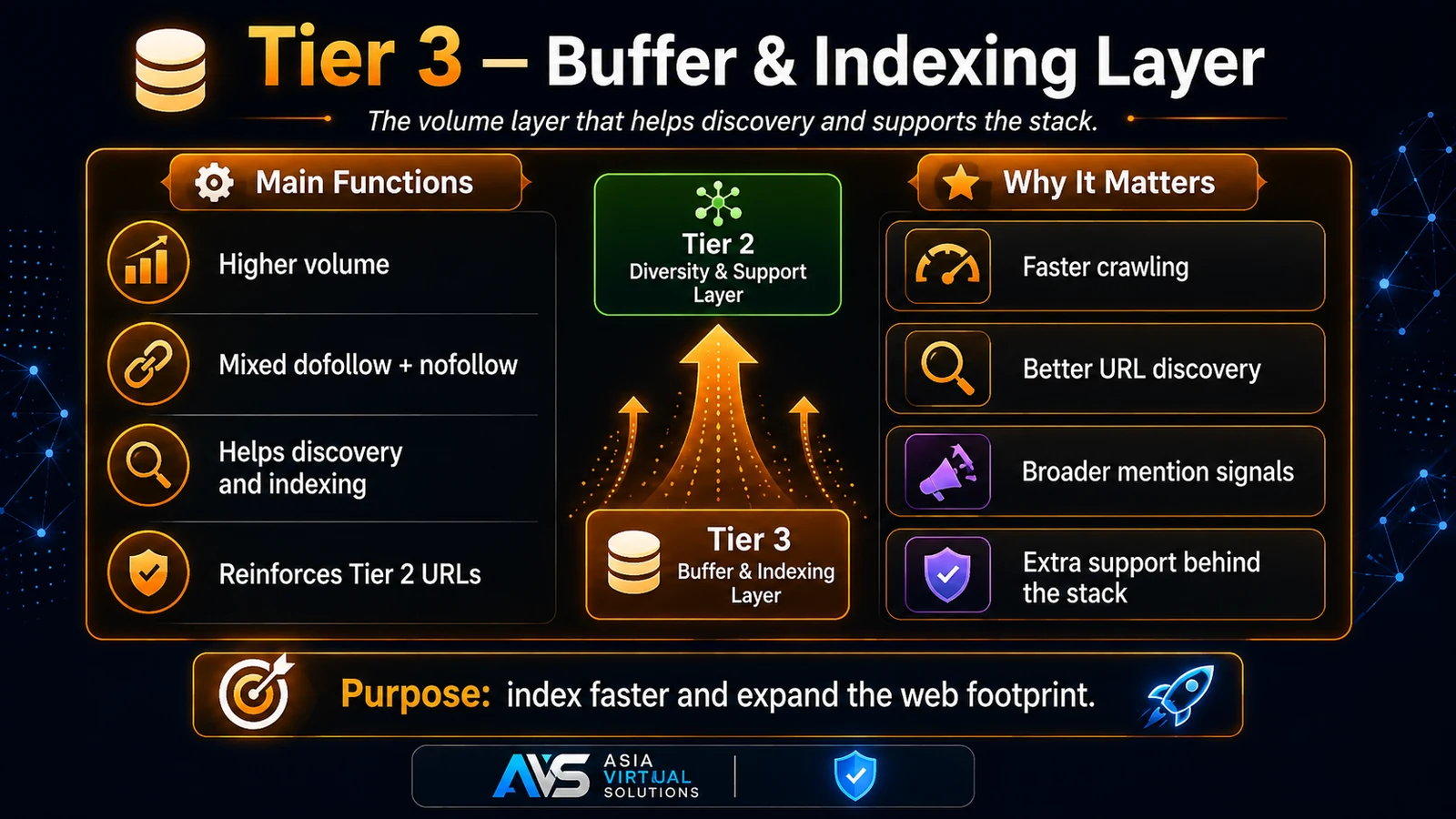
Tier 3 is the high-scale support layer. It generally points toward Tier 2 and gives the campaign additional crawl paths, discovery opportunities and supporting link volume without sending that entire footprint directly at the money site.
Tier 3 Has a Different Job
Set the three tiers side by side and the division is obvious:
| Tier | Job | What you optimise for |
|---|---|---|
| Tier 1 | Quality and control | Placement selectivity and content depth |
| Tier 2 | Diversity and reinforcement | Platform variety and support coverage |
| Tier 3 | Scale and discovery | Volume and crawl paths |
Tier 3 is the layer where volume is the point. It is also the layer where you can stop agonising over individual placements, because no individual Tier 3 link matters much on its own.
Typical Tier 3 Characteristics
- high volume relative to the tiers above it
- the widest platform mix in the campaign
- a natural blend of dofollow and nofollow links
- broad crawl paths feeding back into Tier 2
- reinforcement of Tier 2 URLs specifically
- additional mentions and URL discovery across the open web
Content standards drop at Tier 3, and that is by design. The content still needs to be readable enough to be accepted and to survive, but nobody needs a carefully argued essay sitting three layers below the money site.
Are Nofollow Links Useless?
No, but they do not do the same job as a followed link. Three things are true at once:
- Nofollow links are not equivalent to followed links for conventional ranking purposes. Google says links marked
nofollowwill generally not be followed. - They can still have value for referral traffic, brand exposure, mentions and a naturally varied backlink profile, while the linked URL may also be discovered through other sources such as sitemaps or links from other sites.
- A backlink profile made entirely of followed links is unusual. Real websites accumulate both.
The practical rule: do not reject a useful placement purely because of the attribute, and do not build a strategy that depends on nofollow links behaving like followed ones. Both mistakes come from wanting a simpler answer than the situation offers.
Indexing Expectations
Link creation, crawling, discovery and indexing are four separate events, and only the first is under your control.
A backlink can exist and never be indexed. A supporting link can be crawled without producing any measurable ranking effect. A page can be indexed today and dropped next month. None of that means the layer failed.
If you use a paid indexing service, treat it as improving the odds of discovery rather than as a guarantee of inclusion. Nobody can promise Google will index a URL, and any service that does is selling you something it does not control.
You are not buying indexation. You are widening the number of paths that lead into your structure.
The Parasite / Authority Content Layer
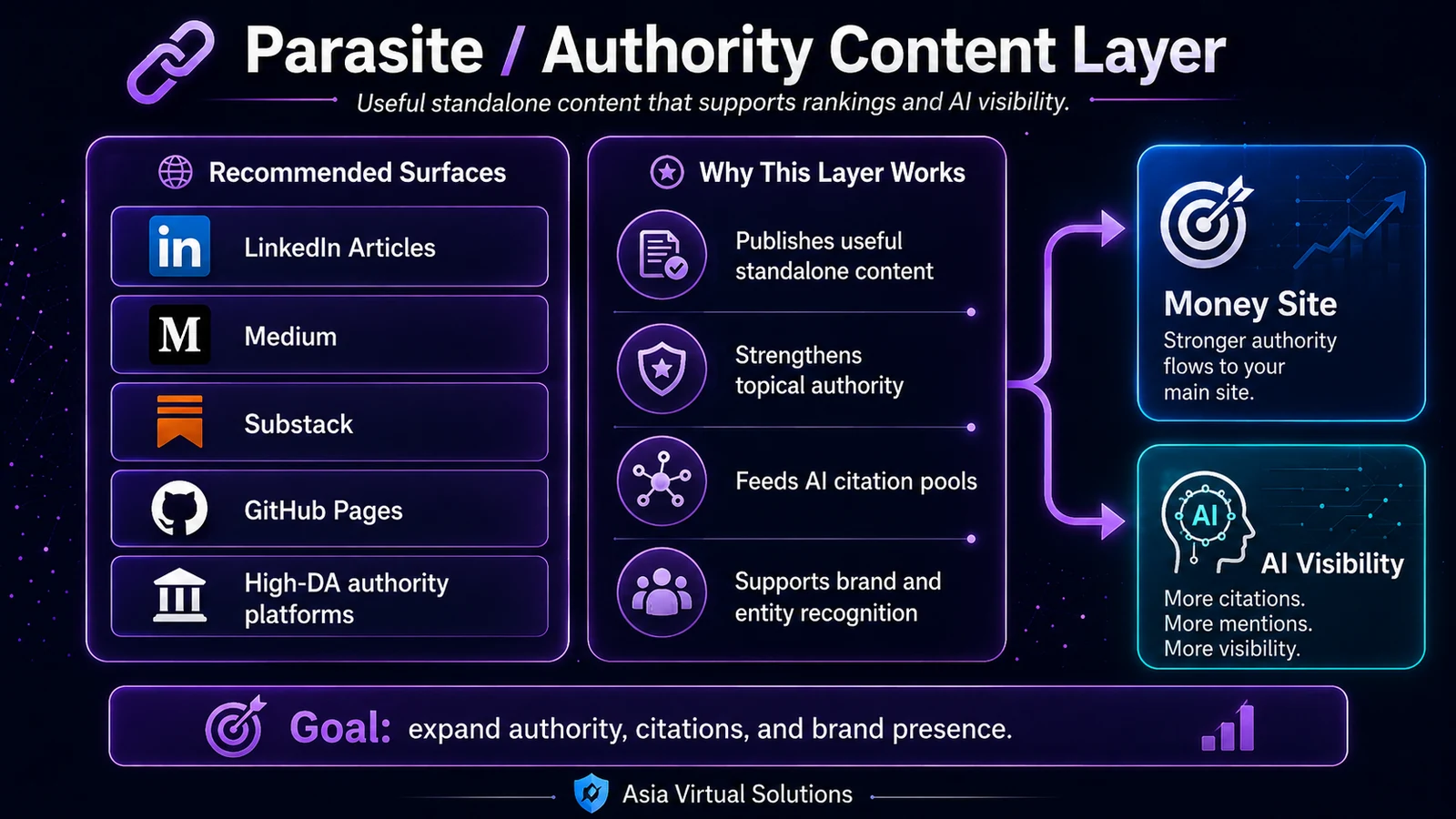
The authority layer consists of useful standalone content published on established third-party platforms, where the page may be discovered independently while also reinforcing your brand, topic or target site.
Recommended Types of Authority Surfaces
- LinkedIn Articles
- Medium
- Substack
- GitHub Pages
- established Web 2.0 properties with real editorial standing
- industry publishing platforms in your niche
- any legitimate high-authority site that permits the content you want to publish
That last condition is the important one. Publish where publishing is allowed, under an account that is yours, following the platform’s rules. Nothing in this layer requires impersonation, cloaking or abuse, and campaigns that go that route tend to lose the asset exactly when it starts working.
Why This Is Different From Tier 1
Tier 1 exists as part of a backlink structure. The article is there because the link needs somewhere to live.
Authority content inverts that. The article is the point. The link is a consequence.
Written that way, an authority piece can:
- rank independently for its own queries
- attract links you did not build
- put your brand name in front of a new audience
- link contextually to useful pages on your site
- strengthen the association between your brand and its topic
- occupy an additional search result for queries you care about
- widen the public information footprint around your topic or entity
One good authority article can outlive an entire tier of automated placements. It is worth the extra effort it takes.
How Authority Content May Support AI Visibility
Careful wording matters here, because this is the area where the SEO industry is currently making the loudest unverifiable claims.
What can be said with confidence: AI-powered search and retrieval systems draw on publicly available information across many web sources. Publishing useful information across legitimate authority surfaces can broaden the number of places where:
- your business is mentioned
- your brand is associated with a topic
- your product or service is described in context
- expertise is demonstrated
- entity relationships are reinforced across independent sources
What cannot be said: that any of this guarantees an AI citation. It does not. No technique does, and anyone selling guaranteed ChatGPT citations is describing an outcome they cannot control.
The realistic objective is a stronger, more consistent and more discoverable public information footprint. If a retrieval system encounters your brand described the same way across several independent sources, that is a better position than being invisible outside your own domain. That is the whole claim, and it is enough.
Parasite SEO vs Spam
“Parasite SEO” covers an enormous range of behaviour, from perfectly ordinary guest publishing to outright abuse of hacked properties.
In this article the term means one thing only: publishing useful standalone content on established third-party platforms that permit it.
It does not mean hacked sites, injected pages, purchased or stolen accounts, expired-domain hijacking or anything else that relies on a platform not noticing. Those approaches are outside what we recommend, and they are also fragile. Anything that depends on nobody looking stops working the moment someone looks.
Permission from the platform is not the whole test. Content published mainly to take advantage of a host site’s established ranking signals may fall under Google’s site reputation abuse policy. The safer objective is to publish useful standalone content that serves the platform’s own audience, with any backlink secondary to the content itself.
Build the Workflow Faster With GSA SER Builder
Understanding this workflow takes about twenty minutes. Preparing every project field, article, email account, anchor group and tier relationship by hand is what takes the afternoon.
What Has to Be Prepared Manually Without a Builder
For a three-tier project, before you can press start:
- unique articles for every tier, with different quality levels per tier
- email accounts, enough of them, working
- project fields filled in for each tier
- anchor-text groups (main, secondary, branding, partial) per tier
- article titles
- images to embed where platforms accept them
- platform and engine selections per tier
- filters (language, country, outbound links, keyword exclusions)
- tier relationships so each project targets the correct parent
- optional URLs, video links and media fields
- the overall campaign structure
- final project configuration and a saved restore file
None of that is difficult. It is just long. Doing it properly for three tiers is a solid afternoon of clicking, and it is the reason most people run one badly configured project instead of three well configured ones.
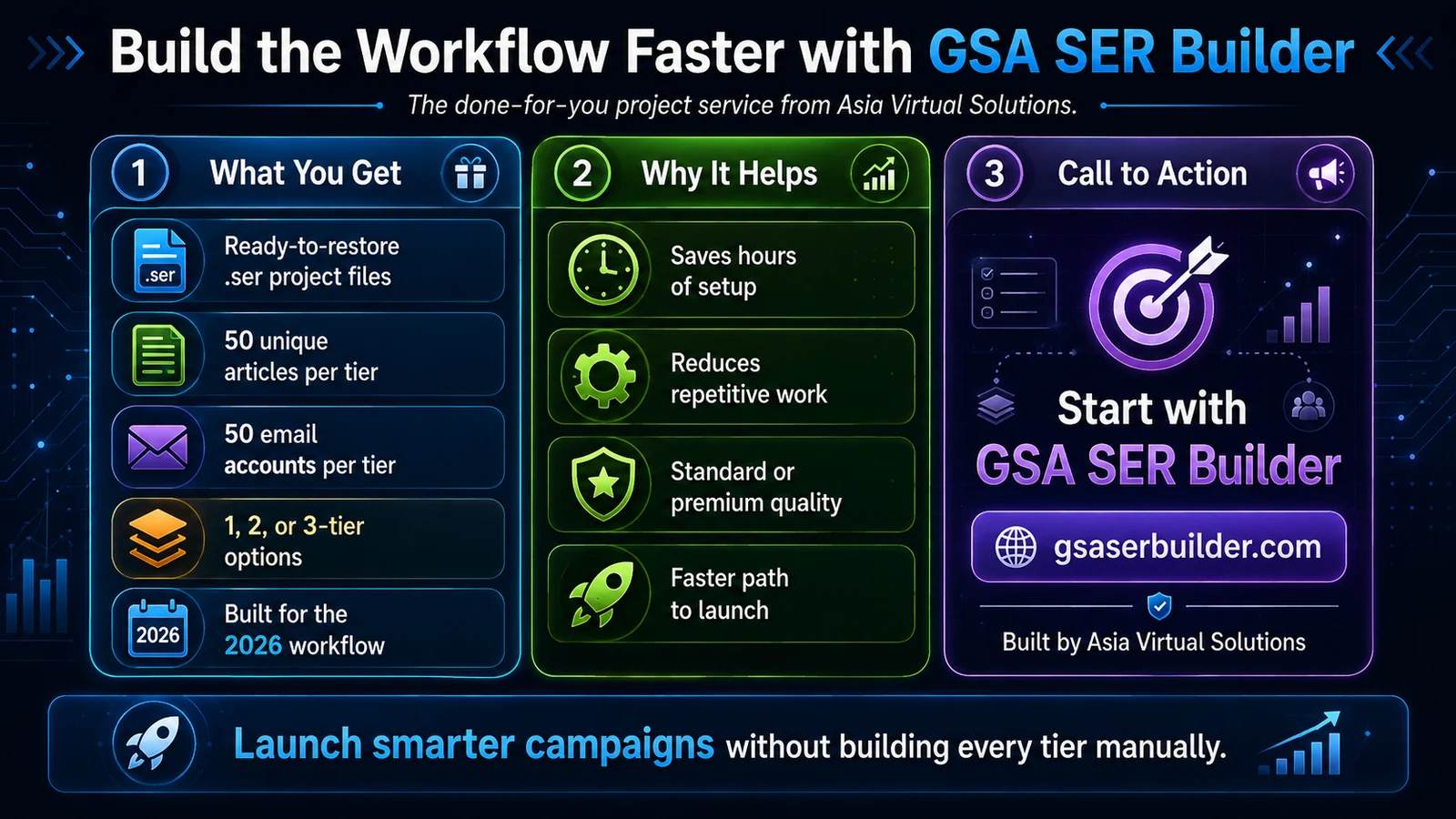
What GSA SER Builder Provides
GSA SER Builder generates the whole structure and delivers it as a .ser restore file you import straight into GSA Search Engine Ranker. Quantities scale per tier, at 50 unique articles and 50 email accounts for each tier in the package:
| Package | Unique articles | Email accounts | Configured tiers |
|---|---|---|---|
| 1 Tier | 50 | 50 | 1 |
| 2 Tiers | 100 | 100 | 2 |
| 3 Tiers | 150 | 150 | 3 |
| 5 Tiers | 250 | 250 | 5 |
Every package includes:
- a fully configured project structure for the tiers you selected
- anchor-text groups covering main, secondary, branding and partial anchors
- GSA linking tokens embedded in the content
- preselected platform choices per tier
- filters and project settings
- relevant scraped images
- the final
.serrestore file
Optional fields are available for YouTube links, image URLs, HTML banners and iframes, and social-profile URLs, for platforms that accept them.
Check the current package contents and pricing on the GSA SER Builder site before ordering, since the specification is updated as the service develops.
Standard vs Premium Content
There are two content levels, and the choice maps onto the architecture in this article. Standard produces cost-effective professional content that suits supporting tiers and general campaigns. Premium produces deeper, more refined articles, which is where you want your Tier 1 content to come from.
At the time of writing, the builder lists a GPT-4-class engine for Standard and Claude Sonnet for Premium. Model providers change, so confirm the current engines on the product page rather than relying on this article a year from now.
Put better resources closer to the important target.
A sensible split on a three-tier campaign is Premium content for the tier that touches your money site, Standard for everything below it. That is the same logic that governs the rest of the workflow, applied to the content budget.
If you would rather not touch the configuration at all, our done-for-you GSA SER projects cover the full build, and there is a one-hour expert setup session if your existing installation needs auditing first.
Launching, Measuring and Improving Your GSA SER Workflow
What Should You Measure After Launch?
Split your metrics into three groups, because they answer three different questions.
Campaign metrics
- verified links
- successful submissions
- surviving URLs after 2–4 weeks
- unique domains, not just unique links
- platform diversity across the verified set
- Tier 1 survival rate specifically
- cost per useful verified placement
Search metrics
- ranking changes for target queries
- Google Search Console impressions
- clicks
- discovered URLs
- indexed URLs
- referring domains over time
Brand & visibility metrics
- branded search volume and visibility
- unlinked brand mentions
- third-party pages ranking for your queries
- entity consistency across platforms
- observed references in AI or search systems
No single metric proves a campaign is working. Verified link count on its own proves almost nothing. Read them together, and give the campaign long enough to produce a signal before you start changing variables.
The 2026 Workflow Checklist
Money site
- Useful target page that deserves to rank
- Clear topic and entity focus
- Internal linking into the target page
- Sensible anchor targets defined
Tier 1
- Contextual placements only
- Controlled volume
- Strong, readable content
- Conservative anchor profile
Tier 2
- Diverse platform mix
- Higher velocity than Tier 1
- Links aimed at Tier 1 URLs, not the money site
Tier 3
- Higher scale
- Mixed platforms, mixed link attributes
- Supports Tier 2 URLs
Authority layer
- Useful standalone content
- Legitimate publishing surface
- Brand and entity mentions
- Natural contextual links
Monitoring
- Verify links after submission
- Re-check survival after a few weeks
- Monitor indexing and discovery
- Review the anchor profile as it grows
- Move support toward what is working
Frequently Asked Questions
Yes. GSA Search Engine Ranker remains useful as an automation platform. Poor results often come from outdated platform selection, content, anchors or campaign structure rather than from the software alone.
Selected contextual placements can be used as Tier 1 links to a money site. Lower-value or high-volume link types are generally better kept deeper in the tier structure, pointing at Tier 1 and Tier 2 URLs instead.
There is no universal number. The 10 to 20 links per day shown in the infographic is a controlled example, not a fixed rule. Site age, existing link velocity, niche and the number of target pages all change the answer.
Tier 2 is a support layer that normally points at Tier 1 URLs. Its purpose is to add diversity, create additional discovery paths and reinforce the Tier 1 pages that link to your money site.
Tier 3 is a higher-scale support layer that generally points at Tier 2 rather than directly at the money site. It contributes volume, crawl paths and discovery rather than direct authority.
No, but they do not do the same job as a followed link. Google says links marked nofollow will generally not be followed, so they are not equivalent for conventional ranking purposes. They can still provide referral traffic, brand exposure, mentions and profile diversity, and the linked URL may be discovered through other sources such as sitemaps.
Parasite SEO means publishing content on established third-party platforms so the content can benefit from the host platform’s existing visibility. Platform permission alone does not make a placement compliant with Google Search policies. Content published mainly to exploit a host’s ranking signals may fall under Google’s site reputation abuse policy.
It can broaden the publicly discoverable information associated with a brand, topic or entity, which is the prerequisite for being retrieved. It does not guarantee inclusion or citation by any AI system, and no technique currently does.
GSA SER Builder is a service that generates complete, restore-ready GSA Search Engine Ranker projects, including unique articles, email accounts, anchor groups, platform selections, filters and tier relationships, delivered as a .ser file. Packages cover one, two, three and five tiers. Details are at gsaserbuilder.com.
No. GSA SER Builder prepares complete restore-ready project structures according to the package you choose, so the manual work is reduced to importing the file and starting the project.
Final Thoughts: Build a System, Not Just Backlinks
GSA Search Engine Ranker is still powerful because it automates work that would otherwise be impossible to do by hand. That has not changed and is unlikely to.
What has changed is that the automation now needs a strategy sitting in front of it.
The old model
Money Site ← Everything
The modern model
Tier 3 → Tier 2 → Tier 1 → Money Site
running alongside
Authority Content → Money Site + wider search visibility
The rule that holds the whole thing together is simple enough to remember without the diagram: the closer a link sits to your money site, the more deliberate you should be about it. The deeper into the support layers you go, the more room there is for scale and diversity.
Build the structure once, properly. Then let the automation do what automation is good at.
Want the Project Built for You?
Building articles, email accounts, anchor groups, project fields and tier relationships by hand takes hours before a single link goes out.
GSA SER Builder prepares complete one-, two-, three- and five-tier GSA SER projects with the content and resources included in the package you select, delivered as a .ser file ready to restore into GSA Search Engine Ranker.














 English
  বাংলা
বাংলা  简体中文
简体中文  Nederlands
  Français
  Deutsch (Sie)
  हिन्दी
  Bahasa Indonesia
  Italiano
  日本語
日本語  한국어
한국어  Bahasa Melayu
  Português do Brasil
  Русский
  Español de México
  Tagalog
  ไทย
ไทย  Tiếng Việt
  اردو
اردو  Türkçe