



Many users of our XEvil IPv6 Proxies for reCAPTCHA service have asked why their IPv6 proxy IPs never change. We built this explanation and FAQ to clear up the confusion, so you can see how our IPv6 proxies work and why your front-end proxies always stay the same.
Quick answer
- The IPs in your proxy files are front-end proxies. They are the door into our proxy server, not the address a website sees.
- Behind that door, every connection leaves through a proxy tunnel that picks a fresh IP from a large rotating pool.
- So Google sees a different IPv6 address on each request while your proxy files stay exactly the same. Nothing is broken.
- IPv6 is the right tool for reCAPTCHA solving with XEvil. The address pool is huge, the price per IP is low, and Google accepts IPv6 connections.
- IPv6 is the wrong tool for GSA SER link building. Most target sites still answer on IPv4 only, so use HTTP or SOCKS proxies for that job.
What Are IPv6 Proxies?
An IPv6 proxy is a server that sits between you and the site you are visiting, and it uses the IPv6 protocol to carry that traffic. Instead of showing your own IP address, the site sees the address the proxy gives it. That is useful for web scraping, for reaching content that is limited by region, and above all for solving CAPTCHAs with tools like XEvil.
How Do IPv6 Proxies Work?
Your connection does not go straight from your device to the website. It passes through the proxy server, and that happens in two steps.
- Reaching the proxy server (the front-end proxies). We send you two proxy files, one for HTTP and one for SOCKS. Each file holds the IP addresses and ports you use to connect to our proxy server. These are the front-end proxies. They do not change, even when you renew, because they are the access points to our system.
- The proxy tunnel and IP rotation. Once you are connected, your traffic travels through a proxy tunnel. The address a site like Google sees is not the one in your proxy file. Each connection is given a new IP from a large rotating pool. You always dial the same front-end IPs, and Google still sees a different address every time.

What’s the Difference Between Regular HTTP Proxies and IPv6 Proxies?
Many of our users run automated link-building tools such as GSA Search Engine Ranker, RankerX or SEO NEO. Those tools connect to thousands of different websites to register accounts, post content and build backlinks, so they need proxies that can reach almost anything. That is why they run on HTTP or SOCKS proxies, usually replaced every month. Here is how the two types compare.
| HTTP / SOCKS proxies (IPv4) | IPv6 proxies | |
|---|---|---|
| Best job | Link building with GSA SER, RankerX, SEO NEO | reCAPTCHA and hCaptcha solving with XEvil |
| What it can reach | Almost any website on the internet | Only sites that publish an IPv6 address |
| Cost per IP | Higher. IPv4 addresses are a scarce, traded resource | Much lower. The IPv6 pool is effectively unlimited |
| Replacement | Usually a fresh batch every month | No replacement needed. The tunnel rotates for you |
| Ban behaviour | Burns slowly across many small targets | Burns fast if pointed at ordinary websites |
| Authentication | IP authorisation | IP authorisation |
1. Usage in Automated Link-Building Tools
HTTP / SOCKS proxies

Tools like GSA Search Engine Ranker and RankerX have to reach a very wide spread of sites, and most of those sites still answer on IPv4 only. Regular HTTP or SOCKS proxies, whether public, semi-dedicated or dedicated, handle that without compatibility trouble. That is why they remain the default for the posting side of a campaign.
IPv6 proxies

Google supports IPv6, but plenty of other software and websites still do not. Point IPv6 proxies at the ordinary web and a large share of your targets simply will not answer, while the ones that do will ban the range quickly. That makes them a poor and expensive fit for the link-building part of the job.
2. Performance with CAPTCHA Solving Tools
HTTP / SOCKS proxies

Link-building tools lean on a CAPTCHA service such as XEvil to clear image CAPTCHAs and Google reCAPTCHA. IPv4 proxies do that work on ordinary sites without trouble, but they struggle against Google itself. Google watches IPv4 ranges closely, and a shared or recycled IPv4 address is often flagged before it gets a chance to solve anything.
IPv6 proxies

This is where IPv6 earns its place. Google accepts IPv6 connections, and the address pool is so large that a fresh address on every request costs almost nothing. Your solving requests keep arriving from addresses with no history, which is exactly what reCAPTCHA scoring reacts to. It works for this narrow job and not for the wider one.
3. Cost and Longevity
HTTP / SOCKS proxies

IPv4 proxies are normally swapped for a fresh batch each month when they are used with link-building tools. IPv4 space is finite and traded, so the price per address stays high. What you get for it is reach, and for the posting side of a campaign reach is what matters.
IPv6 proxies

Per address, IPv6 is far cheaper, which is the whole reason the rotating pool is affordable. The cost only turns against you when the proxies are used for the wrong task. Send them at ordinary websites and they burn through addresses fast for very little return, and you end up paying for volume you never used.
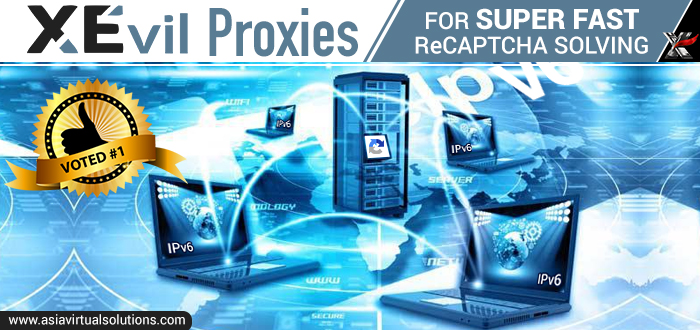
Why We Recommend IPv6 Proxies for CAPTCHA Solving
Use each type for the job it is good at. HTTP and SOCKS proxies do the posting, because they can reach the whole web. IPv6 proxies do the CAPTCHA solving, because that traffic goes to one place, Google, and Google speaks IPv6. Running both is not doubling up. It is the cheapest way to keep a campaign moving.
Proxies Frequently Asked Questions (FAQ)
Why do the proxy IPs I receive never change?
The IPs in your proxy files are front-end proxies, and they are static on purpose. They are the access points to our proxy server. Google and other sites never see them. What those sites see comes from the rotating pool on the back end, which changes constantly.
What does Google see when I use the proxies?
Not the IPs from your proxy file. When your traffic passes through the proxy tunnel, each connection is handed a different address from the rotating pool, so Google sees a new IPv6 address on every request.
How is my anonymity protected?
Because the back end rotates addresses, there is no single IP for a site to build a profile around. Your own address is never exposed to the destination. The site only ever sees whichever pool address served that request.
What is the difference between the HTTP and SOCKS proxies you provide?
The protocol and the port range. Our HTTP proxies use ports 20000 to 20299, and our SOCKS proxies use ports 21000 to 21299. SOCKS is the more flexible of the two because it carries any kind of traffic, not just web traffic. HTTP is simpler and still the common choice for browser-based work. Both files are sent to you at the same time, so you can use whichever your software prefers.
Why do I need IP authorisation instead of a username and password?
You authorise the IP address of the machine that will use the proxies, and after that the connection just works. There is no login to store in a config file and nothing to leak if that file is shared. It also means a stolen proxy list is useless to anyone else, because their IP is not on the allow list.
Can I use these proxies for CAPTCHA solving with XEvil?
That is what they are built for. They are tuned for automated CAPTCHA solving and work with XEvil on Google reCAPTCHA and hCaptcha. Drop them into your XEvil proxy settings and no other configuration is needed.
How often do the IPs rotate?
Per connection, not on a timer. Each new request through the tunnel is assigned a fresh address from the pool, so there is no rotation interval to set and nothing to schedule. Your front-end proxy files stay unchanged the entire time.
Do I need to change my proxy files after subscribing again?
No. The front-end IPs are the same on renewal, so the files you already have keep working. All the address changing happens on our side of the tunnel.
What are IPv6 proxies?
They are proxy servers that route your traffic using IPv6, the newer version of the internet protocol. They act as a gateway between you and the destination, so the destination sees the proxy’s address instead of yours.
How do IPv6 proxies differ from IPv4 proxies?
The size of the address space, and what that does to price and availability. IPv4 has about 4.3 billion addresses in total and the regional registries ran out of free ones years ago, which is why an IPv4 address costs real money. IPv6 has 2128 addresses, a number large enough that no provider needs to ration them. The trade-off is reach: a site has to publish an IPv6 address before an IPv6 proxy can talk to it, and many still do not.
Why should I use IPv6 proxies?
For one reason above all others: cheap, plentiful addresses for talking to services that already support IPv6. Google is the one that matters here, which is what makes IPv6 the sensible choice for reCAPTCHA solving. If your target does not support IPv6, there is no benefit at all, and IPv4 is the better buy.
Are IPv6 proxies faster than IPv4 proxies?
Not because of the protocol. IPv6 is not inherently faster than IPv4. What people often notice is fewer hops, because IPv6 traffic usually skips the carrier-grade NAT layers that IPv4 traffic passes through, and less congestion, because fewer connections use IPv6 paths. In practice the speed you get depends far more on the provider’s network and how loaded the server is than on which protocol it runs.
Can IPv6 proxies help protect my privacy online?
Up to a point, and it is worth being clear about where that point is. A proxy hides your real IP address from the site you are visiting, and a rotating pool means each request arrives from a different address. That is the whole of the benefit. A proxy does not encrypt your traffic the way a VPN does, and it does nothing about cookies, browser fingerprinting, or an account you are already signed in to.
Are IPv6 proxies compatible with all devices and operating systems?
Every current desktop and mobile operating system handles IPv6, including Windows, macOS, Linux, iOS and Android. The gap is usually not the operating system but the application. Older software, and some SEO tools, were written for IPv4 and will ignore an IPv6 proxy entry. Check that the tool supports IPv6 before you buy.
How do I set up an IPv6 proxy on my device?
You need the proxy address and port, and an authorised IP on our side. From there you paste the details into whichever program will use them, which for most of our customers is XEvil rather than the operating system’s own network settings. Your machine also needs working IPv6 connectivity from its own internet provider. If you are unsure, send us a message and we will check it with you.
Can I use IPv6 proxies for web scraping or automated tasks?
Yes, as long as the site you are scraping answers on IPv6. When it does, a rotating pool is a good fit, because rate limits and soft blocks are usually applied per address. When it does not, the request fails outright and an IPv4 proxy is what you need.
Are IPv6 proxies legal to use?
Using a proxy is legal in most countries. What decides the answer is what you do through it. Checking how your own site looks from another country, doing market research, and solving CAPTCHAs for software you have paid for are ordinary uses. A proxy does not make anything legal that was not legal already, and a few countries do restrict proxy and VPN use, so check your local rules.

IPv6 Statistics
IPv6 stopped being a future protocol at some point in early 2026. These are the measured figures, with the source and date for each, so you can check them yourself rather than take our word for it.
| Measurement | Figure | Source and date |
|---|---|---|
| Google users arriving over IPv6 | 50.10%, the first time it passed half | Google IPv6 statistics, 28 March 2026 |
| Worldwide IPv6 capability | 42% | APNIC Labs, April 2026 |
| Average across all measurement sources | 43% | Internet Society Pulse, April 2026 |
| Highest national adoption | France 73%, India 72%, Saudi Arabia 65% | Internet Society Pulse, 2026 |
| Lowest national adoption | Italy 17%, Spain 10%, Egypt 4% | Internet Society Pulse, 2026 |
| Total IPv4 address space | About 4.3 billion addresses (232) | IETF, exhausted at the registries since 2011–2019 |
| Total IPv6 address space | 2128 addresses | RFC 8200 |
Two things follow from that table, and both matter if you are buying proxies. Roughly half of Google’s traffic is IPv6, which is why IPv6 proxies work so well against reCAPTCHA. And adoption is wildly uneven between countries, which is why an IPv6 proxy still cannot reach large parts of the ordinary web.
IPv6 External Resources Used
These are the sources behind the figures above. All were live when we checked them on 8 September 2026.
- Google IPv6 statistics – Google’s own live measurement of how many of its users arrive over IPv6, with a per-country map.
- APNIC Labs IPv6 measurement – an independent daily measurement of IPv6 capability, broken down by economy and network.
- Internet Society Pulse – averages several measurement sources rather than relying on one.
- Google hits 50% IPv6 – APNIC’s write-up of the milestone and why the different measurements disagree.
- 18 Years Later, IPv6 Reaches Majority – the per-country breakdown quoted in the table above.
- RFC 8200 – the IPv6 specification itself, if you want the primary source for the address format.
- Internet Society IPv6 FAQ – plain-language answers on adoption and IPv4 exhaustion.
- ARIN: IP Addresses Through 2025 – what the North American registry actually has left, from the registry itself.
- IPv4 address exhaustion – the timeline of when each registry ran out, which explains today’s IPv4 prices.
- Comparison of IPv6 support in operating systems – a useful reality check on which systems still have limited IPv6 support.
IPv6 Proxies – Conclusion
The static IPs in your proxy files are only the way in. Behind them, every connection is routed through a rotating pool, which is what keeps your activity from being tied to a single address. That design is what makes the service work for solving CAPTCHAs with XEvil, for scraping IPv6-enabled sites, and for reaching content that is limited by region.
Asia Virtual Solutions sells both kinds. IPv4 HTTP and SOCKS proxies for GSA Search Engine Ranker and the rest of your link building, and IPv6 proxies for XEvil reCAPTCHA solving. Most customers running a full campaign use both. Pick the one you need below.








 English
  简体中文
简体中文  Deutsch (Sie)
  Bahasa Indonesia
  Italiano
  日本語
日本語  한국어
한국어  Português do Brasil
  Русский
  Español de México
  ไทย
ไทย  Tiếng Việt
  Türkçe